



In the aftermath of Bad Bunny’s Super Bowl halftime show, there have been many opinions shared online. Those against the show mostly criticize the terribly vulgar music or the lack of English spoken in what should be a very traditional American stage. Those in favor argue along the lines that the show “gave a voice to those oppressed or suffering unjustly under the Trump administration” and was a great way of “representing Latin-American culture”.
I don’t care to comment on the strained logic required to convince oneself that the guy who sings the following lyrics “actually does it for the oppressed minorities”:


Instead, I want to focus on a less-commented aspect of the show, which annoyed me personally even more than the twerking or the the reductive stereotyping that treats all Latin-Americans as a monolithic culture defined by its most vulgar expressions: the misuse of the word “love” to once again further sin and vice under the pretext of tolerance.
There was one particular billboard which many praised and celebrated:


I don’t doubt that Wesley and those who agree with him genuinely believe they’re on the side of love. The problem isn’t their intent, but the fact that they’ve unknowingly accepted a counterfeit definition of what love actually is.
On the surface, this sounds like a good, loving message. If we didn’t know any better, we would think that promoting “love over hate” would be the moral thing to do.
But the problem is that we do know better, because for the past few decades, the word love has been perverted and misused in order to shut down any voice that dares reject the notion that human freedom should be ordered towards virtue instead of vice. And the word “hate” has been arbitrarily assigned to anyone who seeks to promote any form of objective morality that requires self-restraint and self-denial.


This is a rhetorical strategy that the left has successfully deployed for decades. The tactic works in two steps: First, claim the moral high ground by branding your own side as "loving," "compassionate," or "on the right side of history."
Second, label anyone who disagrees as "hateful," "fascist," or "Nazi." Once this frame is established, rational debate becomes impossible. Disagree with their policy? They don't need to address your argument, they just point to their label ("We stand for love") and yours (which they've assigned you: "bigot, racist, nazi, intolerant, ____"), and the conversation is over.
The shocking thing is how effective this tactic is. Just look at the guy from the earlier tweet. He actually believes that because a billboard says “love is stronger than hate”, those who placed the billboard are the loving side and those who disagree with it are the “hateful” side. This rhetorical strategy works perfectly on those who don't examine language carefully, who remain at surface level instead of engaging the deeper philosophical and metaphysical meanings. They accept the most comfortable interpretation because critical thinking about words requires effort most people don't even realize is needed.
Another user very accurately commented on that post with a popular meme:


Another Tweet I saw explained this problem very eloquently, and motivated me to write this article:


In this article, I want to talk about the concept of love, what it truly means (and what it doesn’t), and finish with some words of warning about the huge responsibility that we all have to use words correctly.
I will do my best to write this from a place of Christian charity, trying my hardest to speak the truth lovingly. I encourage you to read with that same spirit, and if something I write challenges you or strikes a nerve, I ask that you pause and consider the argument on its merits rather than reacting to how it feels in the moment.
What Love Isn’t
Deacon Garlick further Tweeted:
The liberal, new-age concept of “love” has a simple meaning: the unrestricted acceptance of any and all human choices made by anyone in exercise of his or her freedom. The problem with this definition is that it treats freedom itself as the measure of goodness. If someone freely chose it, the thinking goes, then it must be morally acceptable. But this is obviously false, and nearly everyone would agree: not all freely chosen actions are good.
This is precisely the distinction Deacon Garlick makes in his follow-up: there are two competing visions of freedom.
True, good, freedom means pursuing virtue by disciplining disordered desires. And only that freedom leads to love.
The other form of freedom (maximizing options to satisfy base desires) leads to sin, decay, and suffering, not just for the one acting freely but immorally, but for society at large.
This is where the disagreements over the word “love” come from. Many have unknowingly started to understand “love” in this counterfeit manner, as mere acceptance or tolerance, instead as the active virtue of desiring what is good for someone else. This leads to thinking that “accepting” someone’s choice to act in a self-harmful way (by pursuing a sexually deviant lifestyle, for example) is the loving thing to do.
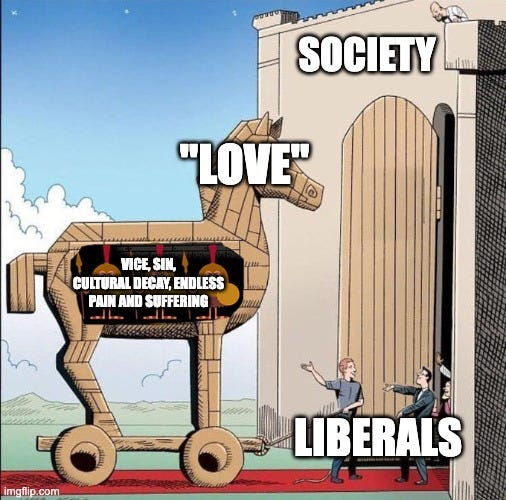
True freedom (disciplining desires to pursue virtue) leads to love because love, by its nature, is directed toward the good. As the Catechism puts it: 'Only the good can be loved.'1
Thus, we cannot simply call tolerance, empathy, or acceptance “love” and be done with it. Love has a specific, much more demanding meaning, one that requires far more from us than mere tolerance or acceptance ever could.
So what is love, properly understood?
What Love Is
Saint Thomas Aquinas wrote “To love is to will the good of another.”2 The Catechism of the Catholic Church continues: “All other affections have their source in this first movement of the human heart toward the good. Only the good can be loved.”3
We can immediately see why the post-modern liberal version of “love” falls short. Their version of love is passive and unchallenging: “just allow everyone to do whatever they wish and don’t make moral claims about their choices.” This sounds compassionate, but it’s actually a comfortable, passive abandonment of the other to the negative consequences of their actions (which isn’t loving).
But love demands an active willing of the good of the other, and that requires us speaking up when someone is acting in a way that would cause them harm. It requires us rejecting harmful ideologies and inmoral choices, and it demands wanting the best for our fellow men.
The loving thing to do is willing the good of another, even when that requires us disagreeing with their choices. Love, then, is by definition intolerant of evil, intolerant of sin, and intolerant of all those things that harm ourselves and our neighbor.

Why This Matters
I believe a big reason why culture has decayed so much over the past few decades is that we’ve failed to preserve language and we’ve fallen for the rhetorical tricks that are so characteristic of the dark forces of evil and confusion.
Consider how every major cultural battle of the 21st century revolves around language: The abortion debate redefines “human life.” The gender debates redefine “man,” “woman,” “sex,” and “gender.” The immigration debates redefine “nation,” “country,” and “dignity.”
Every cultural battle starts with language, and that is why it’s so important for us to be precise in our speech, to not give up linguistic ground and to fight for the proper use of words.
I wrote an article towards the end of last year diving deeper into the importance of proper language. You can read it here:
The Vulgarization of Language

As I pace the bookstore, something about the “Best-Sellers” section catches my eye. There is a striking uniformity in the books in this category, not because of their bright colors or corporate-looki…
The billboard said “The only thing more powerful than hate is love.” And they're right about one thing: love is more powerful than hate. But they're catastrophically wrong about what love actually is.
Real love is far more demanding, far more costly, and far more beautiful than the shallow acceptance or tolerance they're peddling. It requires courage to speak truth to people who don't want to hear it. It requires sacrifice to desire someone's genuine flourishing over their temporary comfort. And it requires wisdom to discern between the compassion that heals and the sentimentality that enables destruction.
This is the love that the world desperately needs. True, Christian love. Not the tolerance that says “do whatever you want, even if it hurts you”, but the charity that says “I want what's good for you, even when you can't see it yet.”
May we have the courage to love like this and to continue speaking the truth firmly and charitably.
Ad Maiora Nati Sumus,
Juan

Thank you for reading!
If you enjoyed this post and could leave a like or comment it would be greatly appreciated, as it will help my work reach more people.
If you liked this article, you’ll love my books.

CCC 1766
St. Thomas Aquinas, STh I-II, 26, 4, corp. art.
CCC 1766
Ultimately, liberal love comes straight from Satan. It is a myth to say devils never talk of love, they actually do all the time because they mourn the love they have lost in His Grace.
However, in the mind of a devil now is an empty, Graceless, mockery of love which serves oneself. There is no sacrifice in this love because it is conditional on what one receives in return, it is the glorification and edification of self over the other. We see this in liberal love, it is a love of pleasure, consumerist and transactional and conditional on being a liberal, if you are not then, as you say, you are a fascist, etc.
Sadly, it is this love that the Man of Lawlessness will promote, they won't come to power proclaiming hate and frothing at the mouth but proclaiming 'love', 'peace' 'order' and stability and bring exactly the opposite of all this. Liberal love is paving the way for the rise of the Antichrist and its gaining purchase and traction in society. Standing opposed to that is the real, Grace-filled, love of the Cross which we are to carry in us and continue to be the light of the world as the darkness closes in around us.
Per usual, Chesterton has some golden commentary: “Tolerance is the virtue of the man without convictions…In real life, people who are most bigoted are the people who have no convictions at all.
Bigotry may be roughly defined as the anger of men who have no opinions.”