


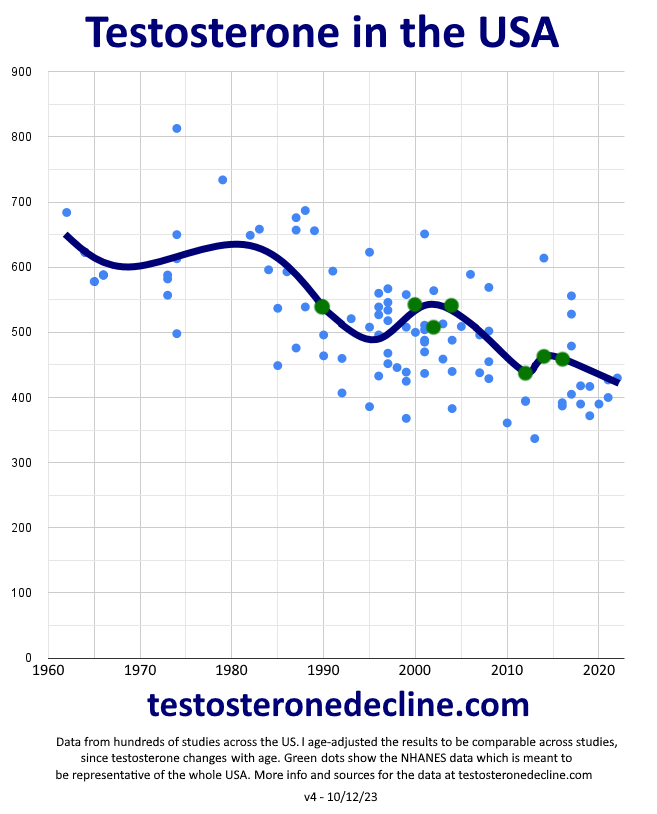
There’s been a lot said about the great decline in testosterone levels in men over the last couple of decades. Some studies estimate that testosterone levels among males have been declining an average of 1% every year1, with other studies showing a decline of 35% between 1960 and 20222:
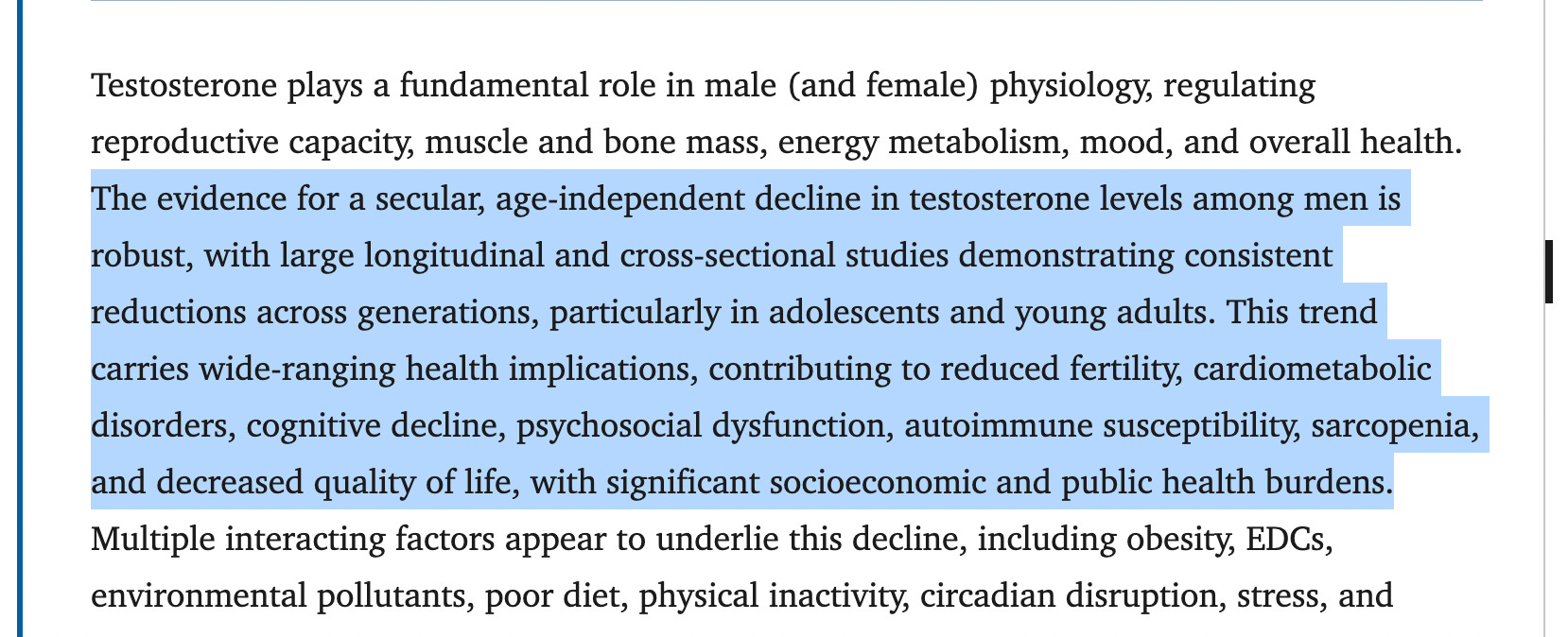
This has become a mainstream talking point, and almost all who have investigated this issue agree that the decline in testosterone levels among western men is a serious cause for concern3:
Many solutions have been proposed, and many men have jumped on the “optimization” bandwagon to try and recover the fire that has been stolen from them by a hyper-industrialized society and the accompanying toxic environment it has created.
We’ve correctly identified the problem (testosterone is declining) and many men have made a committed decision to try and stop that decline in their own lives. But I’d argue that we haven’t properly identified the solution.
Yes, external factors are partly the culprits of this decline: chemicals in the water and food, microplastics in your bloodstream, blue lights disturbing the quality of your sleep, and sedentary office jobs all contribute significantly to making men less masculine by draining them from their testosterone.
Beyond the external factors, however, there is another layer to this problem, one that doesn’t get spoken about nearly as often: the spiritual dimension. Our bodies and souls are interconnected, tangled beyond our understanding, and there is no physical problem that isn’t mirrored in the spiritual realm, or vice versa.
The decline in testosterone is very real, but I believe we won’t stop it by tackling it with a naturalistic solution. After all, the decline in testosterone —a physical reality—, reflects a spiritual vice —effeminacy—, and until we take a holistic approach to masculinity, we’ll always fail to solve this problem that is plaguing most young men.
What is Effeminacy?
Effeminacy, as St. Thomas Aquinas defines it, is the vice that is opposite of the virtue of perseverance, namely, “when a man is ready to forsake a good on account of difficulties which he cannot endure.” St Thomas continues and explains: “This is what we understand by effeminacy, because a thing is said to be ‘soft’ if it readily yields to the touch.” St Thomas also describes effeminacy as a reluctance to suffer due to an attachment to pleasure.
Effeminacy, then, is when a man refuses to do what he needs to do, out of fear of dealing with hardships or losing his precious comforts, to which he is disorderly attached. He is a slave to comfort and his worldly pleasures become more important to him than the pursuit of virtue or acting righteously as a man.
This showcases a sort of spiritual “softness”, in which the actions of a man are determined not by morality, values, or principles, but by that which is easier and most comfortable. In other words: the effeminate man chooses comfort over duty, ease over effort, pleasure over perseverance.
You can see how this is connected to the decline in testosterone: effeminate men do less hard things, just like men with low testosterone. Like we said earlier, the spiritual vice of effeminacy becomes mirrored in the physical world, manifesting as low testosterone, with all the negative consequences that it carries.
It’s genuinely worrying to see the downward trend of both fortitude and testosterone, and if we look backwards, at our parents and grandparents, we can see what this great decline looks like:
The Generational Decline
Your Grandfather: Woke up at 4:30 AM without an alarm because his body was a finely-tuned machine completely submitted to his will. Ate three eggs, black coffee, and yesterday’s bread without scrolling through his phone. Worked 10 hours of manual labor, lifting heavy things repeatedly until his back hurt and doing it again the whole week. Came home, fixed the car, built half a shed, ate whatever your grandmother put in front of him without commenting on the seasoning, then went to bed at 9 PM. Never once mentioned being tired. His hobbies included smoking and “sitting quietly.” He could open any jar in the house with one hand.
Testosterone: 800 ng/dl
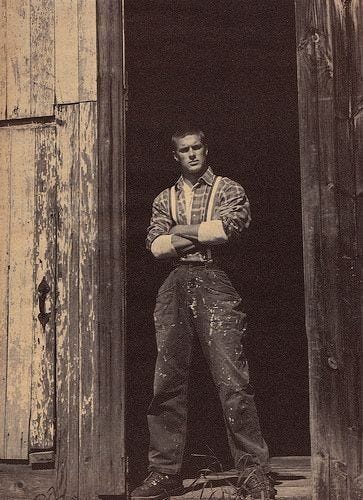
Your Father: Woke up at 6:30 AM to an alarm clock that didn’t even have a “snooze” button. Kissed his wife good morning and ate a simple breakfast before commuting to his office job, dressed impeccably and clean-shaven (maybe sporting a mustache). Worked 8 hours without a single complaint, walking around the office, reviewing physical papers and visiting client’s offices. Occasionally wore a Hawaiian shirt on the weekends while he grilled and mowed the lawn. Opened all jars easily (with both hands).
Testosterone: 600 ng/dl

The average 30-year old modern man: The alarm bell rings at 7 am and he snoozes it 5 times until 7:50. Wakes up in a hurry and eats sugary cereal (or an avocado toast that he posts to Instagram if he has some time) and a soy milk latte. Goes to work in a pastel-colored scooter, dressed in something that is basically sweatpants and a hoodie. He works from his laptop for 8 hours, under blue lights, and never once moves from his desk (except to go to the bathroom or cafeteria). Comes home “exhausted” from the zoom calls to binge watch “Friends” and order thai food alone or with a his dog/cat. Can’t open jars without the specialized rubber grip tool he bought on Amazon. Loves being “comfy”.
Testosterone: 400 ng/dl

Yes, yes, I know I’m exaggerating. Not every man fits these exact descriptions. But the pattern is undeniable. Our grandfathers lived completely different lives, much less comfortable ones, and not only did they have more testosterone (as shown by the earlier graphs), but effeminacy also wasn’t a problem for them: it was simply impossible to go through life without enduring some form of hardship and discomfort, and that forced them to become stronger men. We don’t need —in the most literal sense— to be strong to survive or even thrive in a world that has made sure that weakness in men is normalized (or even incentivized). And because of that, whereas before fortitude was the natural baseline, now the baseline is effeminacy.
So how do we actually reverse this? How do we break the generational decline and recover the fire that’s been stolen from us before it's too late, especially for those of us who’ll raise the next generation of men?