




The book of Job is one of the most widely discussed and cited books of the entire Bible, mostly because it presents us with a striking example of undeserved suffering that necessarily challenges our own sense of justice.
Most of us are familiar with Job’s story: a righteous man loses everything for seemingly no reason other than God allowing the devil to test him.
Now there was a day when the sons of God came to present themselves before the Lord, and Satan also came among them. The Lord said to Satan, “From where have you come?” Satan answered the Lord and said, “From going to and fro on the earth, and from walking up and down on it.” And the Lord said to Satan, “Have you considered my servant Job, that there is none like him on the earth, a blameless and upright man, who fears God and turns away from evil?”
Then Satan answered the Lord and said, “Does Job fear God for no reason? Have you not put a hedge around him and his house and all that he has, on every side? You have blessed the work of his hands, and his possessions have increased in the land. But stretch out your hand and touch all that he has, and he will curse you to your face.” And the Lord said to Satan, “Behold, all that he has is in your hand. Only against him do not stretch out your hand.” So Satan went out from the presence of the Lord.
— Job 1:6-12
After God allows Satan to attack Job, the blameless man loses everything. His children die, his property is destroyed, and even his livestock and his servants die. In one day, Job’s blessed life becomes a life marked by deep suffering, and yet, he refuses to speak against God:
Then Job arose and tore his robe and shaved his head and fell on the ground and worshiped. And he said, “Naked I came from my mother’s womb, and naked shall I return. The Lord gave, and the Lord has taken away; blessed be the name of the Lord.”
— Job 1:20
Job's story perfectly depicts the seemingly unjust suffering we all face at some point. Maybe you feel like Job when negative circumstances pile up without any apparent reason: losing your job, losing a loved one or facing illness. God, in His wisdom, knows too well that at some point in our lives (and possibly more than once), we’ll raise our arms up to the heavens and demand an answer to the ever painful question: “What did I do to deserve this?”
The book of Job gives us an answer.
Thank you for reading Ad Aeternum! If you’re enjoying our work, please consider upgrading to a premium subscription to support us and get access to:
Exclusive, in-depth articles every Saturday
Access to the entire archive of essays
Group chat access and subscriber Q&As plus many upcoming member benefits
Undeserved Suffering
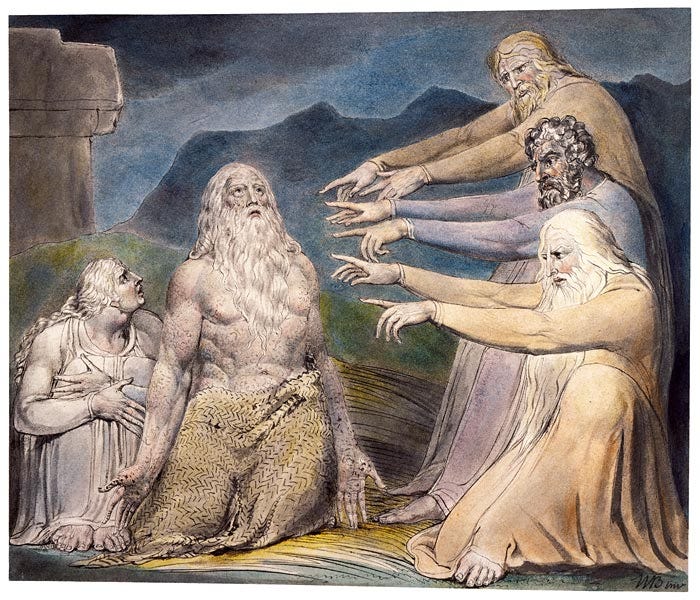
The remarkable part about Job’s story is not so much the suffering he faces, but the fact that it’s one of the only cases in the Bible in which said suffering is clearly undeserved. There are tons of stories of great sinners facing pain and struggle as a consequence of their disobedience, but almost no stories —beyond Job’s— of righteous men facing terrible consequences after having committed no sin.
A big part of what makes Job’s story so relatable is that we see in it the lack of answers from God that we often feel in our own lives. As the readers, we know what’s happening and we know that Job is being tested (chapters 1-2 reveal Satan’s test with God’s permission). But Job has no idea. And his ignorance is reminiscent of our very own confusion when suffering comes without us doing anything to deserve it.
Precisely because suffering is such a common experience between all of us who walk this valley of tears, I want to take a look at Job’s story from a different angle and try to offer some comfort to anyone who might be suffering and failing to find an explanation for his tribulations.
Bear in mind, the answers we find in the book of Job are comforting, but they are not what, in the midst of our pain, we might expect or desire.
The Prosperity Gospel and Its Consequences
When trying times come, we usually think like Job’s friends’: we assume that suffering is a sort of karmic, direct punishment for personal sin, and thus conclude that if we are suffering, it has to be because we’ve done something wrong. The theology of Job’s friends, who supposedly come to comfort him, is a version of the “prosperity Gospel”, so popular over the last decades, that seeks to minimize our faith to the following equation:
Good behavior = blessing, bad behavior = punishment.
This is a sort of theology that feels right because it makes the world predictable and controllable, and it plays on our need to feel secure: if suffering is simply a response to bad actions, then it’s in our power to avoid it completely. Many Christians unconsciously believe this, and Job’s friends certainly did:
Eliphaz claims that he must be guilty because “innocent people don’t suffer like this”
Bildad takes it one step further and blames him for the death of his children: “Your children died because they sinned”
Zophar, unsatisfied with the poor man’s suffering decides to tell him, “you deserve worse”
The “comforting” words of Job’s friends end up adding insult to injury. Not only is Job suffering, but he’s now also —they claim— fully deserving of it.
Once again, we can see how this reflects our real life. Or is it not true that very often, in suffering, not only are we forced to bear the weight of pain, but also the crushing weight of loneliness and criticism from those who think we deserve what we are getting?
Job finally cracks, and rebukes his “friends: “Miserable comforters are you all!” (16:2). At this point, his faith reaches a breaking point, and he demands answers from above: “Why are You doing this to me?” (Chapters 3-31)
God hears his cry, and His response is a strong proclamation of sovereignty.

When God’s Answer Explains Nothing
When God finally shows up, He provides an answer that, on the surface, offers no comfort. It’s not even an answer. He doesn’t offer an explanation. Instead, He asks Job over seventy questions simply to show Him that there are some things he isn’t supposed to understand:
“Where were you when I laid the earth’s foundation?”
“Have you commanded the morning?”
“Can you control Behemoth or Leviathan?”
God isn’t saying all of this to beat Job down and “show him who’s boss.” No, He’s making a broader point:
“If you can’t understand how I run the physical world, why think you can understand My purposes?”
God never says why He allowed Job to suffer, or explains that His tribulations were a test to prove his faith, nor does He even mention Satan.
His answer is simply a striking proof of His greatness, and showcases the difference in wisdom and knowledge between all of us, represented in Job, and Him, who’s sovereign, and infinite.
Job’s response further proves the sheer virtue of the man:
I had heard of thee by the hearing of the ear, but now my eye sees thee; therefore I despise myself, and repent in dust and ashes.
— Job 42:5-7
Imagine that. After suffering greatly, facing the death of his family, the criticism of his friends, and the loss of everything he has, Job accepts his fate and repents, even though he didn’t get the answers that he wanted. What he got, though, was God’s presence. And that was enough for him.
Job’s book is full of meaningful lessons and reassurance for those of us who are under the burden of suffering. Mainly, there are 5 points we can extract from Job’s story, that will help us face the trials and struggles that feel unjust without breaking down, and that will help us endure them gracefully and faithfully.