



Most people believe the political spectrum is something like this:
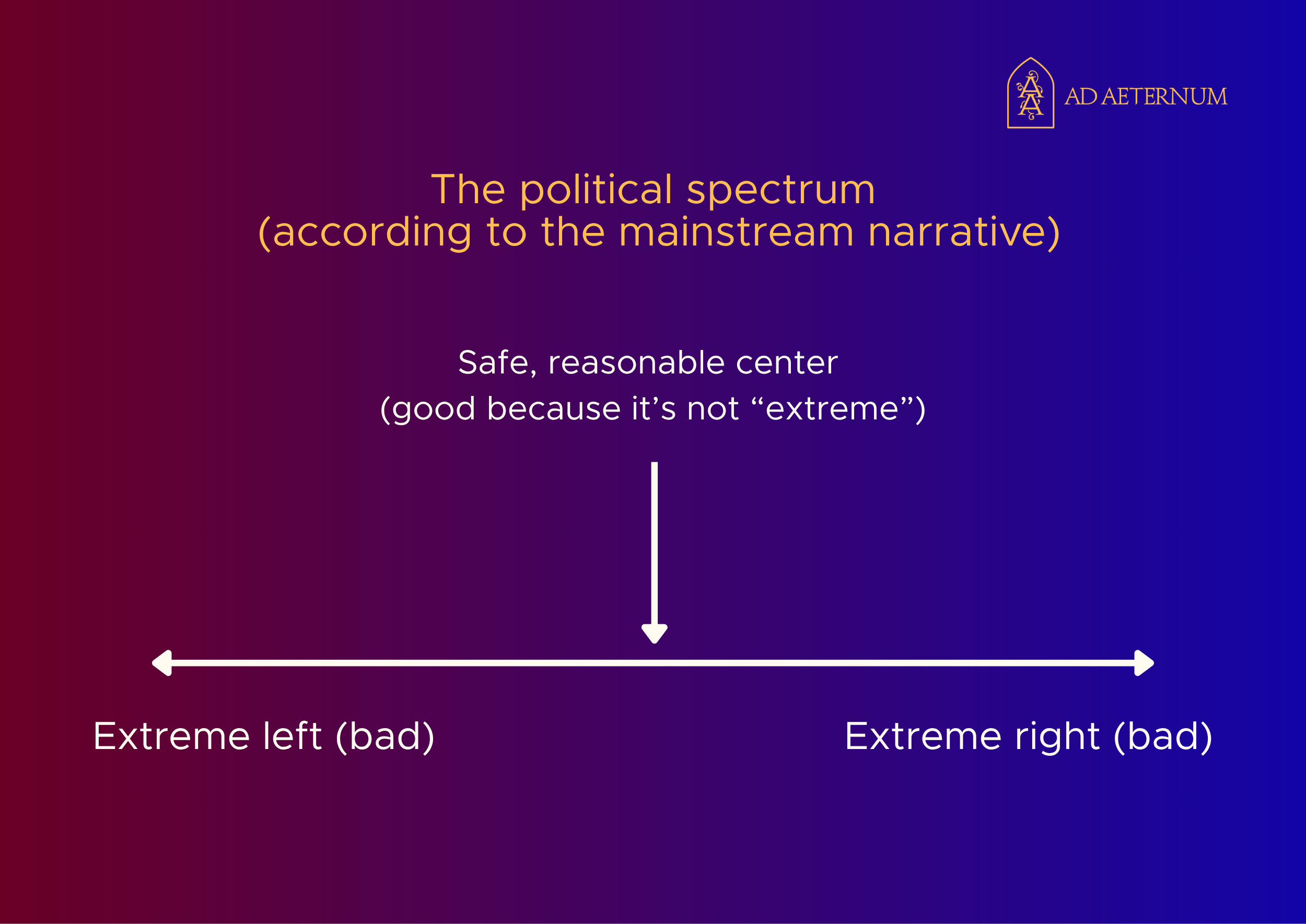
The assumption embedded in that image —which most believe— is that the center is where wisdom and prudence live, that the extremes are inherently dangerous and that moving toward either end is necessarily negative.
But there’s a massive problem with that view, and that is that the scale that we’re using to measure “extremes” is not fixed or objective. Beyond that, we’ve fallen for rhetorical tricks that have convinced us that every “extreme” is necessarily and inherently wrong. This is —as we’ll see— not true at all: extremes can be good when they are morally coherent. There is such a thing as extreme goodness, extreme virtue, extreme and radical rejection of sin. None of those are bad, but they are extremes.
So what if the scale itself is the problem?
The Scale Measures Nothing Fixed
Many believe that the left-right political spectrum is a fixed scale.
But history proves the contrary. The left-right distinction originated in the seating arrangement of the French Revolutionary Assembly in 17891: those who supported the king sat on the right, those who opposed him sat on the left. That is the entire origin of the most dominant political framework in the modern world.
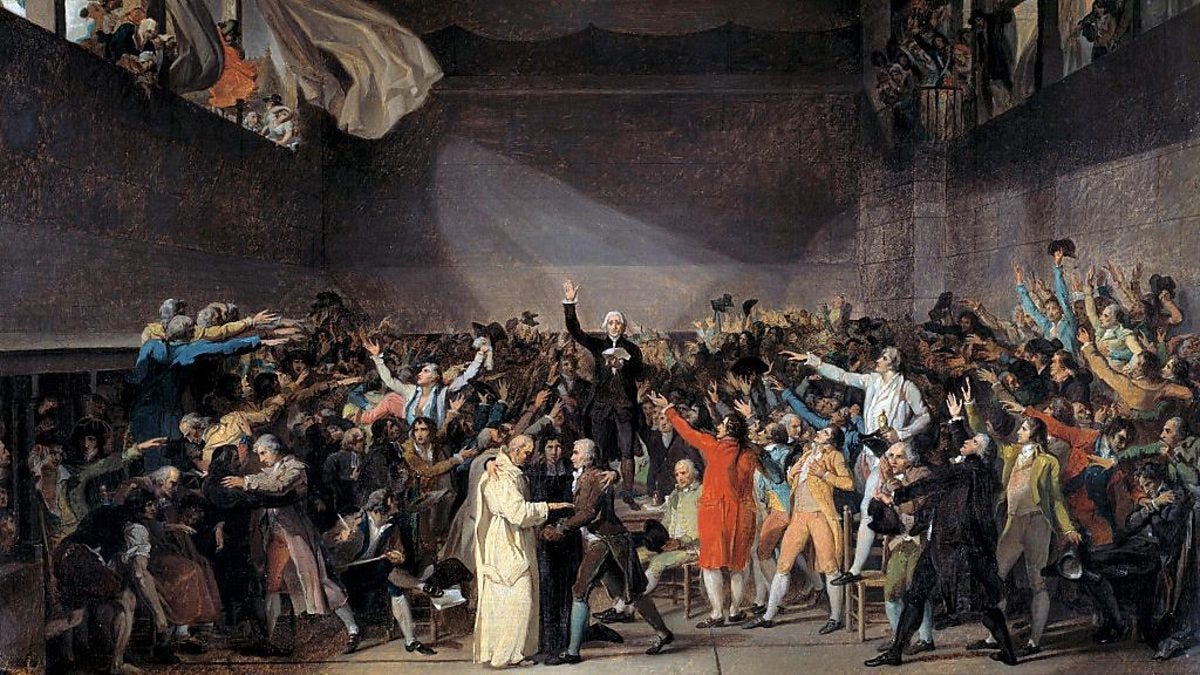
This physical seating arrangement gave rise to the political terminology we use today. The "left" came to symbolize progressive, liberal, and radical ideas, while the "right" became synonymous with conservative and traditionalist values.
— Ronald Dodson, The Left versus the Right
But even though as time went on, these terms became associated with certain specific ideas, “left” and “right” and even “conservative” and “liberal” have meant radically different things in different eras and different countries. What is “moderately liberal” in one decade is “extremely conservative” in the next.
The scale does not measure a fixed moral or political reality. It’s not objective but completely arbitrary, measuring the relative distance from wherever the current consensus happens to be standing.
The Center Lacks a Foundation
You can probably begin to see the problem with the whole right vs. left debate and with aiming for the center as the correct moral option. Those who vote “center” regardless of anything else are basing their opinions on terms that are subjective and undefined: left and right don’t really mean anything fixed, and thus the “center”, being a concept completely dependent on their position on a made up spectrum, means even less.
The man who prides himself on being “centrist” or “moderate” has not found the truth equidistant between two errors. He has simply refused to commit to a position, looked at an arbitrary line, and accepted the assumption that the extremes are inherently problematic.
The center shifts with the consensus — which means the centrist does not hold a stable conviction, but a moving average of whatever the culture currently believes. What was considered “center” two decades ago is considered strongly conservative nowadays, as the Overton Window2 has shifted dramatically to the left since the end of the last millennium. The liberals have become more extreme, and the conservatives have become more liberal. The “center”, which exists simply as a middle point somewhere between the two, devoid of any stable foundation, simply shifts with the window, trying to pass as “reasonable” by presenting itself as “not extreme”.
You can see how aiming for the center by default is a form of intellectual cowardice dressed as reasonableness. It’s the easy way out: instead of choosing a moral code, you simply choose “the center”, knowing that this weak neutrality will likely be accepted by most.
What we should be trying to arrive at is at the Aristotelian mean. And this is not the political center (because it changes with the Overton Window), but the precise point of virtue between two vices (objective and timeless), which requires judgment and wisdom to locate, not merely shunning what is currently being labelled “extreme”. The Aristotelian mean requires you to first know what virtue actually is, which means you cannot locate it by consulting a poll or a political consensus.

Extreme Is Not a Moral Category
The word “extreme” describes a position on a scale, not any sort of moral quality. It’s not wise to choose your political or moral position simply by avoiding what is called “extreme”, because you can be at the extreme of virtue or the extreme of vice —one of them is objectively good, the other one isn’t. And on that same line, the “center” can shift towards all the wrong things, and be false and evil without being labeled “extreme”.
The point is that your moral position should not be determined by a scale that is, after all, completely subjective and liable to being shifted by cultural forces. You shouldn’t shy away from extremes just because, nor should you aim at the center by default.
You can hold an extreme commitment to truth or an extreme commitment to lies. We Christians know and understand this: Christ’s demands are extreme by any reasonable measure. We are called to total self-denial, total love of enemies, the surrender of everything. The saints were extreme. The martyrs were extreme. But they were also right. They were also moral.
What made them right was not that they found the center but that what they were extreme about was worth being extreme about. Something is not wrong because it is extreme. It is wrong because it is false or evil —and those are independent questions.
The Real Question
I want to invite you to think about things differently: strip the left-right framework entirely and replace it with the only question that actually matters: is it true, and is it good? Is it rooted in the eternal moral laws that lead to genuine human flourishing?
A man of conviction does not base his decisions off of a subjective political scale. He challenges it and asks whether it conforms to reality, to reason, and to God. And then he chooses the option that most closely aligns with the eternal laws that are the only source of objective morality there could possibly be.
The center doesn’t give its adherents the moral high-ground, nor is it inherently good by avoiding “extremes”. It is, at best, the safe bet, and at worst, a comfortable excuse for never having to decide what you actually stand for.
Ad Maiora Nati Sumus,
Juan


Thank you for reading!
If you enjoyed this post and could leave a like or comment it would be greatly appreciated, as it will help my work reach more people.
Also, if you liked this article, you’ll love my book.

https://en.wikipedia.org/wiki/Left%E2%80%93right_political_spectrum#History_of_the_terms
https://en.wikipedia.org/wiki/Overton_window
I would remind you that extremism in the defense of liberty is no vice! And let me remind you also that moderation in the pursuit of justice is no virtue! -- Barry Goldwater
Scientifically verifiable (and obvious throughout history) fact: pushing requires more energy than pulling. The pull of your work here is moving, thank you!
I hope many men, and lovers of men, and mothers and other teachers of men, men serving in our military and in positions of power in business and law will be encouraged by reading your work.
Wish my brothers would read it but they don’t read much and are becoming more relativistic in their beliefs. Glad you offer an electronic version too - smart.
May your work prosper 🖖