



I remember vividly getting into multiple heated discussions back when I was in college, when the wave of feminism and individualistic expression was at its highest peak. One of the most emotionally charged topics I ended up arguing about was the question of wanting to have kids in a world considered by the mainstream to be “overpopulated”.
Back then, I didn't have many arguments to respond to the passionate conviction of my classmates, who genuinely believed they were being compassionate by preventing future suffering.
“It’s because of people like you that the world is ending!”
”Humans are a plague and we’ll destroy the world if we don’t stop having kids!”
I understand where they were coming from: if you believe human existence is net-negative, refusing to have children seems like the obvious moral choice. But I now believe this compassionate impulse is built on a deeply flawed and ultimately evil premise.
It’s been refreshing to see that the anti-natalist position has lost a lot of its strength since my college days, mostly due to the economic predictions that prove that our system is financially unsustainable if we don’t revert the population decline we seem to be on in most western societies.
However, I believe there are stronger arguments to be found outside of the field of economics, and those are the ones that I wish to share in this article.
The Danger of Anti-Natalism
The decision not to have kids might seem like an individual choice without any implications beyond the private sphere. But like most things that seem simple on the surface, it’s much more complex than that.
An anti-natalist position requires an underlying conviction that every new human life is a net negative.
Under the anti-natalist worldview, human existence is unjustifiable. The “official” claim is that it’s immoral to bring new life into the world because all life will be inevitably subjected to suffering, pain, and eventual death. This argument, however, smuggles in a deeper, more troubling anti-human claim: that existence itself is unjustifiable. By framing all suffering as unacceptable, the anti-natalist implicitly argues that life (which inevitably includes suffering) is unacceptable. The problem moves seamlessly from suffering to existence itself, and from new life into life as a whole.
If we take these arguments to their logical conclusion, we arrive at a horrifying question:
If it’s immoral to bring someone into existence because they’ll suffer, then isn’t it also moral to end someone’s existence to prevent further suffering?
Think about it: If the problem is suffering, and death ends suffering, then by anti-natalist logic, death is always preferable to continued life. The only difference between the unborn and the living is that one exists and one doesn’t. But if existence itself is the problem, why does that difference matter?
The anti-natalist position, taken seriously, justifies not just preventing birth, but ending life.
This is why anti-natalism is, at its core, a philosophy of death.
The Pipeline of Death
We can see now why taking an anti-natalist worldview is diametrically opposed to the Christian claim that all human life is precious and worth protecting.
There’s a relevant contemporary example that very clearly illustrates where the “having kids will destroy the world” position naturally takes us:
First, under that view, kids become not only inconveniences to the parents’ life, but also immediately guilty for all that’s wrong in the world. You can see this manifest clearly when older people look down with contempt —and often hatred, disgust, judgment and anger— at younger couples with multiple kids. The kids —who are totally innocent— become the inconvenient materialization of their parents selfishness.
From that point, it doesn’t take much to see kids no longer as inconveniences, but as parasites —as we’re seeing among the “pro-choice” activists. It’s much easier to justify the unjust murder of over 73 million unborn lives1 when you stop seeing them as inconvenient humans and see them instead as unwanted parasites.
Finally, they become even less than parasites: mere “clumps of cells”. Humanity —and even life— has been stripped away. We’re there now. And to illustrate just how evil this whole argument is, let me show you what they call a “clump of cells”:
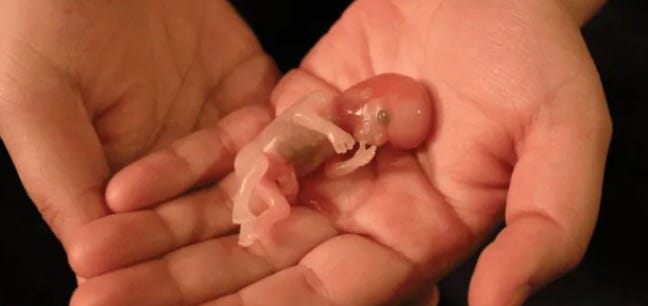
The pipeline looks like this:
Having kids destroys the world (perhaps genuine environmental concern)→ The moral choice is to not have kids (personal choice) → Having kids is inmoral/selfish (philosophical foundation) → Kids are a net negative (overarching claim)→ Existing kids are viewed with contempt (natural emotional reaction to that which is perceived as negative) → We need to prevent births (activist reaction to perceived evil)→ Unborn kids aren’t even kids (rationalization to justify extreme measures)→ Unborn kids are parasites → Unborn kids are clumps of cells → 73 million abortions every year (end result).
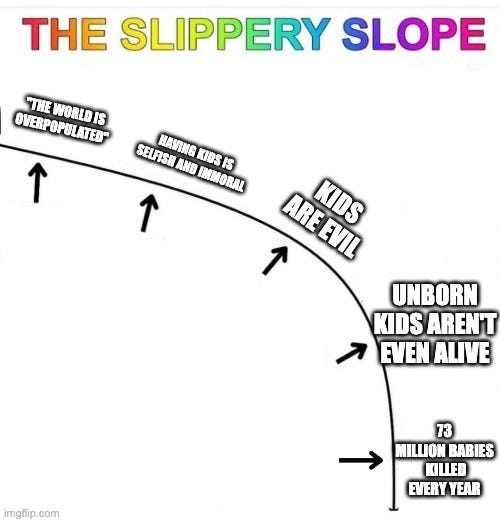
This is where the anti-natalist logic leads: not to a better world with less suffering, but to (at least) 73 million innocent lives taken every year. Not to compassion, but to the industrial-scale destruction of human life.

What the World Truly Needs
Even if I completely dislike the anti-natalist idea, I tend to be somewhat sympathetic towards the individuals who say they don’t want to have children. More often than not, they are victims of a propaganda campaign that is impossible to resist without God’s grace. They genuinely believe they are making a moral choice and they genuinely believe they are saving the world by not having kids.
But being a victim of propaganda doesn't make the propaganda true. And being sincere in your belief doesn't make the belief less deadly.
I don’t have children yet. I can’t speak from the experience of sleepless nights and endless sacrifice. I can only speak from the theological and philosophical truth that sees both the challenge and the profound goodness of bringing new life into the world.
I hope to have many children, if God blesses me with them. I know it will be hard. I know it will require sacrifice that many feel unprepared for. But I also know that the greatest goods always do.
There are many seemingly valid reasons not to have kids, but I believe none of them justify the anti-natalist worldview (and I believe the only moral and intellectually consistent position is the Catholic position of complete openness to life, in which all humans are made in the image of God and thus reflect the divine.
The Christian vision is the only position that actually accomplishes what the anti-natalists claim to want: reduction of suffering and furthering of human happiness and fulfillment. By seeing existence as a gift (not a curse), we learn to see suffering as formative and redemptive, through the example of the Cross. The reality of suffering doesn’t get ignored in Christianity, it gets given meaning.
My answer to those who think that the world is overpopulated, that humans are a plague, and that the world would be better off without more humans in it, is this:
The world doesn’t need less humans, it needs more good ones. It needs men and women who protect God’s creation, starting by protecting His most precious work: human life. The anti-natalist says ‘The world is too broken for children and more children means an even more broken world’.
The Christian, on the other hand, says ‘Children, raised to be good, are how broken worlds are healed.’

God knows us intimately since the beginning of time, and that He’s the author of life. We don’t get to decide to stop the souls He crafted so carefully from coming into the world.
“Before I formed you in the womb I knew you.”
— Jeremiah 1:5
May we all be fruitful and multiply, filling the world with good people who are devoted to the good, true, and beautiful.
Ad Maiora Nati Sumus,
Juan

Thank you for reading!
If you enjoyed this post and could leave a like or comment it would be greatly appreciated, as it will help my work reach more people.
If you liked this article, you’ll love my books.
https://www.who.int/news-room/fact-sheets/detail/abortion
Well written. I wasn’t around for the movement but was for the pro abortion beginnings in college. Between birth control and abortions it was an eye opening experience to what the world was outside my personal upbringing. While I pass on a rather sheltered upbringing for my own children now, I do worry how where the world will head by the time they are adults
Great essay. I remember the zero population growth movement of the 1970s. I didn't buy into it but I know lots of people who did. Be fruitful and multiply in God's image.