


When I rediscovered my faith, one of the first things I did was read the Bible from beginning to end. I realized I couldn’t call myself Christian if I didn’t know or understand the precious central texts of my religion. So I did. This led to a short period in which my faith consisted of just me and my Bible, which I saw as the only necessary guiding light.
And it guided me well. It led me back to Christ. It was a time of incredible change, and a complete reformation of my heart thanks to God’s infinite love.
Slowly, however, questions began to arise. There were things about living as a Christian that I couldn’t derive explicitly from Scripture. I realized that my understanding was limited, and I couldn’t truly grasp the depth and complexity of Scripture on my own. Who was I, after all, but a sinner saved by grace? How could I possibly think that I could understand the entirety of the Bible without a little bit of help?
Ironically, all the “bible-scholars” I found online to guide me disagreed with one another. This further increased my desire to find an authority that could provide clarity and the fullness of the Truth, devoid of the necessary problems of individual human interpretation.
Thus, my dreams to be a “Sola Scriptura” Christian were shattered. I realized I needed an infallible authority beyond Scripture, not to go against it, but to interpret it properly. I was led by the Spirit back to the Church founded by Christ, the only one with a divine guarantee to prevail over the powers of death.
This article is not about my testimony, however. It also won’t be an in-depth breakdown of all the reasons why Sola Scriptura cannot logically be the basis of the Christian faith, but more so a piece showing where Sola Scriptura inevitably leads to, in the hopes that those readers who believe there’s no need for an infallible authority beyond Scripture realize how much the body of believers fragments, degenerates, and becomes lost without it.
Sola Scriptura = You Are the Infallible One
To illustrate my point, allow me to share with you a couple of painful videos and posts.
For context, all of the following speakers are (or claim to be) Christian, all of them claim to follow the Bible faithfully, and all of them claim that Scripture is the only authority you need. All of them also claim to be led by the Holy Spirit and that the Holy Spirit allows them to understand Scripture correctly.


These are just some examples, but the internet is flooded with many more Sola Scriptura teachers, all of them preaching a radically different —and in many cases— dangerously false Gospel.
For the purposes of this post, it’s not necessary to “debunk” their positions (all of which are incredibly easy to disprove with the proper interpretation of Scripture), but simply to show just how easily such outrageous claims could be made once you start trusting yourself to be an authoritative interpreter of Scripture.
So I guess we trust Johnny Chang over Jesus, Who explicitly taught us to pray the Our Father? Or Matt McMillen over James (and Jesus, for that matter)?
These “teachers” are not exceptions to the rule, they are the natural conclusion of Sola Scriptura.
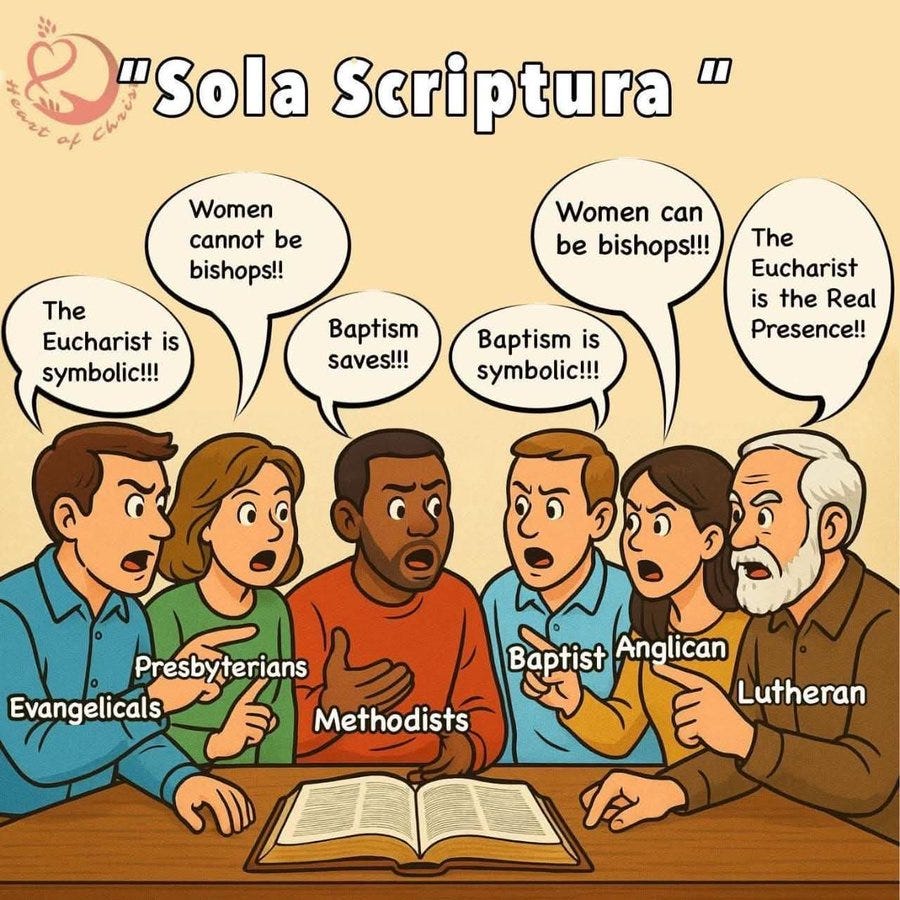
Maybe you watch the earlier “preachers” and you strongly disagree with them. Maybe you say that they are misinterpreting Scripture. But who are we to say they’re wrong? That just puts our own interpretation against theirs.
When there’s no infallible authority beyond Scripture, there’s no correct interpretation of Scripture. There’s no objective Truth. There are only private interpretations, each one “true” in the eyes of the individual and each one “supported” by Scripture.
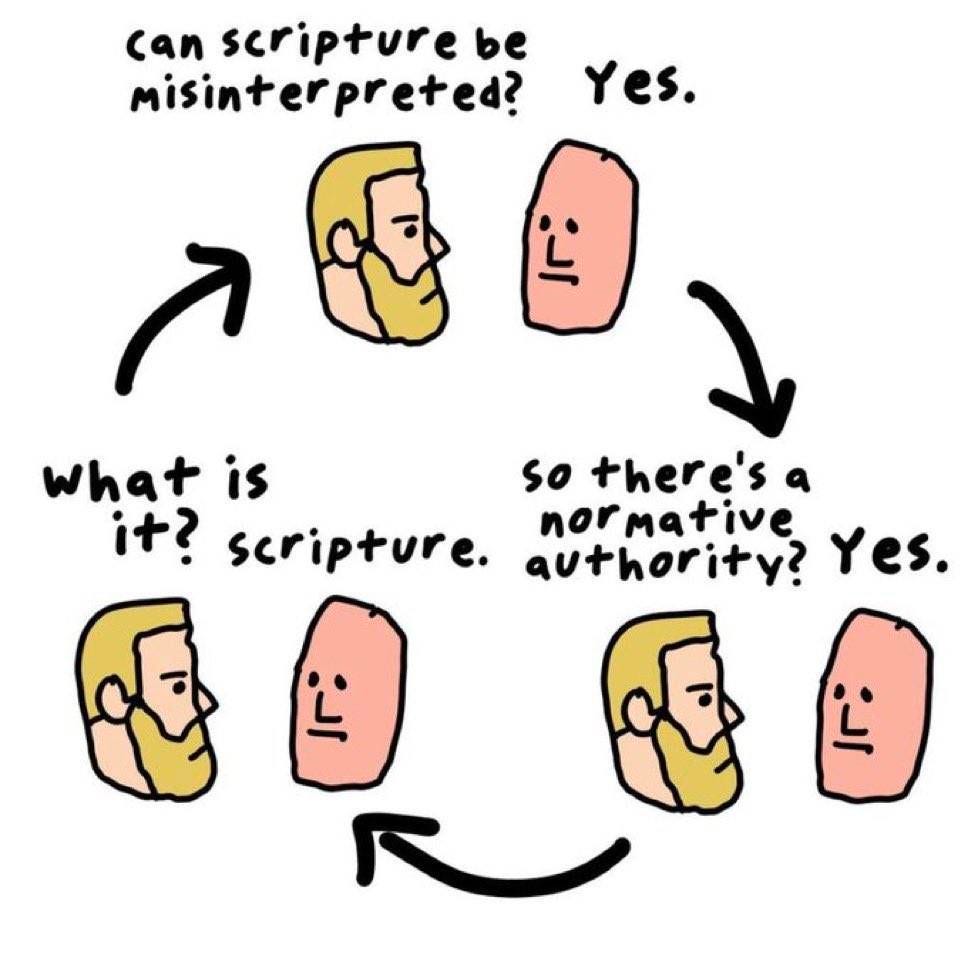
Before we move on, I want to address a common objection that arises when one speaks against Sola Scriptura: that Catholics disrespect or dislike the Word of God. But I want to be very clear: no one is claiming that Scripture isn’t authoritative or infallible, and no one is “dismissing” the importance of Scripture. I’m simply making the point that texts, even divine texts, require an interpreter.
Sola Scriptura protestants often say that Catholics disrespect the Bible by assigning infallibility to a Church that they think goes against it.
But think about it: isn’t it more disrespectful to take something as beautiful as Scripture, filter it through our prideful, sinful hearts, and claim that it’s “because of the Bible” that we make outrageously false and dangerous claims like the ones above?
I would argue that Catholics are the ones who respect the Bible the most, by caring for it so much that we let its proper interpretation be in the hands of the infallible Church that Christ founded, instead of using it to justify our own sins and mislead others, like we see in the examples above.
Relativism has Poisoned the Christian Faith
The Protestant reformation opened the door and allowed relativism and individualism to enter the Christian faith, create division and confusion, and mislead millions of souls.
The takes we see above, and the abundance of false teachers is the natural conclusion of the relativism of Sola Scriptura within Christianity. It allows believers to pick and choose whichever preacher agrees with them, filtering the Gospel through their own preferences, and comfortably drawing towards those who agree with them.
Everyone thinks that “their truth” is “the Truth”, instead of accepting the uncomfortable reality that the fullness of Truth is found only in Christ’s Church, even when we, sinful individuals, disagree with it.
For the time is coming when people will not endure sound teaching, but having itching ears they will accumulate for themselves teachers to suit their own likings.
— 2 Timothy 4:3
If you want a teacher that tells you you’ll never lose your salvation so that you can avoid guilt and fear of eternal damnation, you can find one who tells you that you’re forever saved and will tell you that’s a “biblical” belief.
If you want a teacher that tells you you are free to sin 24/7 so you don’t actually have to make sacrifices and deny yourself, you can find one who tells you Scripture allows you to.
If you want a teacher that tells you there’s no need to repent, you can find one who claims repentance is “unbiblical”.
If you want a teacher that tells you that you can have multiple wives and live a sexually disordered life, you can find one who says “polygamy is biblical”.
But if you want the Truth, the fullness of it, and a deeper relationship with Christ, you will find only one home: the Church He founded, and the one He promised would never fall.
And I tell you, you are Peter, and on this rock I will build my church, and the powers of death shall not prevail against it.
— Matthew 16:18
It’s a Matter of Pride
During my conversion back to Catholicism, one of the most difficult things was realizing that it was pride which was holding me back. I wanted to be my own authority. I wanted to be capable of interpreting Scripture on my own. I didn’t want to submit to the Church.
I say this in all charity, but if you still believe in Sola Scriptura, ask yourself if there’s not a prideful claim to say that you are suited to interpret Scripture on your own. And before saying that it’s the Holy Spirit which lets you interpret it correctly, remember that next door there’s another guy who says the exact same thing and yet claims that the Bible allows him to have multiple wives. Who’s to say he’s wrong and you’re right?
Texts, even inspired texts, don’t interpret themselves, even less so something as complex as the Bible. If you want to understand a poem, you ask the poet what he meant. And if you want to understand the Bible, you consult the people who wrote it, those who learned from them, and the tradition they instituted. St. Paul understood this:
So then, brethren, stand firm and hold to the traditions which you were taught by us, either by word of mouth or by letter.
— 2 Thessalonians 2:15
Why do those who claim Sola Scriptura conveniently ignore all of the verses (like the one above) that call for the maintaining of Church tradition?
There are —in my view— two options, one bad, and one worse:
They ignore them because they are not as smart as they think they are and they clearly cannot interpret Scripture on their own (none of us can). This is the best case scenario.
They ignore them because they know that accepting the authority of the Church would be incredibly demanding, as they would be called to repent, carry their crosses, deny themselves, reject their comfortable beliefs, submit to a higher authority, and truly strive for holiness, instead of thinking they can sin freely and still be saved (examples are the polygamous protestant pastor and Matt McMillen’s ridiculous claims) or thinking themselves the heads of their own churches. This is the worse option, and one that I think is more common than we think.
It’s not easy to accept our own inadequacy. It wasn’t for me at least. And I can’t imagine how difficult it would be for someone who’s been born and raised Protestant, who’s learnt to view the Catholic Church as idolatrous and as their enemy, to muster the necessary courage to accept that they cannot be the arbiters of truth and that they desperately need to accept the Church that Christ founded.
There are echoes of those who rejected the Eucharist that sound whenever someone rejects His Church.
Many of his disciples, when they heard it, said, “This is a hard saying; who can listen to it?”
— John 6:60
If you still are not convinced, ponder on the following questions:
Does the Holy Spirit lead multiple people to multiple radically different interpretations that all disagree with one another?
If not, then why don’t all “Sola Scriptura” Christians agree?Are you 100% certain that you are the one who holds the right interpretation of Scripture? Are you willing to bet your life on it?
Answer honestly, and you’ll know why Sola Scriptura cannot be the basis of your faith.
A Call to Unity
I want to end this article by calling for unity among Christians, under the ecclesiastical authority of the Church Christ instituted. There is no other option. There will be no unity if all we have is the Bible and no Church. There will only be fragmentation and confusion. And there can’t be any unity under any other “denomination”, because only one Church has a divine guarantee to prevail over evil, and that is the Catholic Church.
If you are a Christian of any other denomination, I would encourage you to investigate the actual teachings of the Catholic Church instead of letting yourself be led by the common misconceptions that surround it. There are too many people who hold grudges against the Church and who want nothing more than to convince you to hate it. Do your own research, listen to what the Church actually teaches, and you’ll be surprised by just how Biblical every single practice is. Put it to prayer and be docile to the motions of the Holy Spirit in your heart.
Finally, I’d like to recommend the book Rome Sweet Home by Professor Scott Hahn. If you’re a Protestant, or a convert to Catholicism, I believe this book does a great job showing, through the testimony of Scott and Kimberly Hahn (both former protestants), why an honest search for the Truth necessarily leads back to Catholicism.
I hope you found this article useful, and I genuinely hope it reads as I wrote it: in a spirit of charity and love, hoping that whoever resonates with the points I make can find their way back home, like I did many years ago.
God bless you and may He forever lead you.
Pro regno Dei,
Juan
Thank you for reading!
If you enjoyed this post and could leave a like or comment it would be greatly appreciated, as it will help my work reach more people.
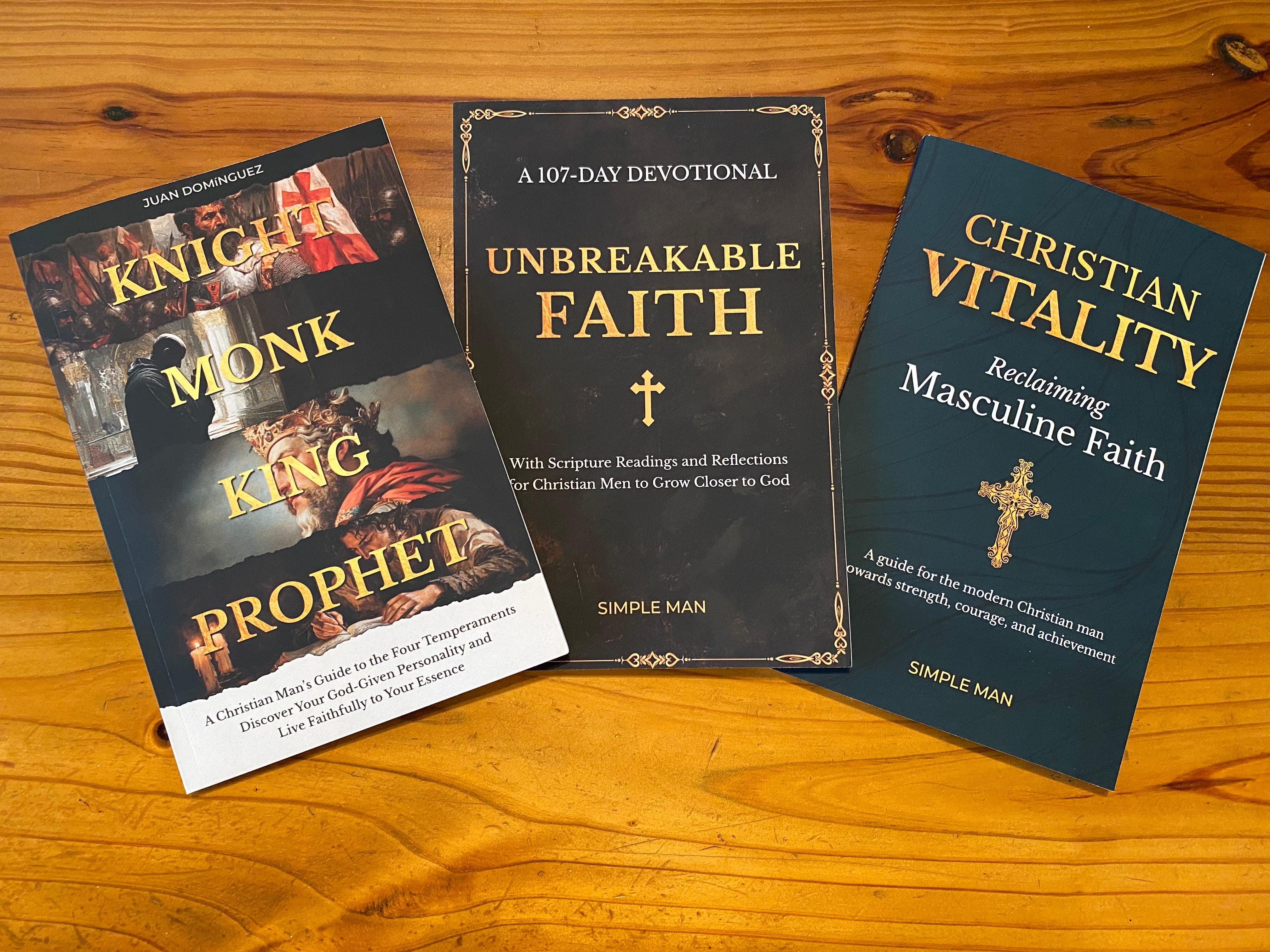
If you liked this article, you’ll love my books.
I'm a Protestant strongly considering the Catholic Church.
Everything you wrote in this article expresses the core reason I am thinking about it, down to a T.
Sola Scriptura produces chaos and disunity. God is not a God of chaos and disunity, but of order and unity.
Excellent essay. In my experience, a very large number of Protestants harbor deep animosity and hatred towards the Catholic Church. When I've rebutted some of these attacks, it became clear to me that they are attacking their idea of what the Catholic faith is, not its reality. Chesterton wrote a pithy line about that.