



The battle against sin can be very discouraging, especially when you feel like you’re making no progress at all towards purifying your thoughts, words, and deeds. It gets to a point when the cycle becomes familiar, so much so that we accept it obediently: the fall, the confession, the resolution, the brief period of clarity, and then the slow return to the same disorder you swore you had finally defeated.
You have addressed lust and found yourself back in it. You have confessed anger and watched it resurface within the week. You have resolved against pride, against avarice, against the particular sin that seems to define your struggle, and you have kept that resolution until you didn't. Slowly, somewhere around the thousandth failure, despair starts to creep in. You are willing to fight, but it seems like you’re fighting a circular battle that has no end.
The reason why this happens is most likely that you’re fighting the wrong battle. Most of the sins you probably recognize, confess, and try to eliminate are symptoms, not root causes. This leads to a mistake in the way you approach them, treating each sin as a separate problem requiring a separate solution. As if lust and anger and avarice were independent failures that could be addressed one at a time, in isolation, without reference to each other.
That approach feels and sounds logical. However, according to a seventh-century Byzantine theologian who paid for his convictions with his tongue and his right hand, it is structurally wrong, because sins are not separate. It’s not like each sin is a tree that you can cut off independently. No, according to St. Maximus the Confessor, sins are all branches of the same tree. And you have been pruning branches while the root goes untouched.
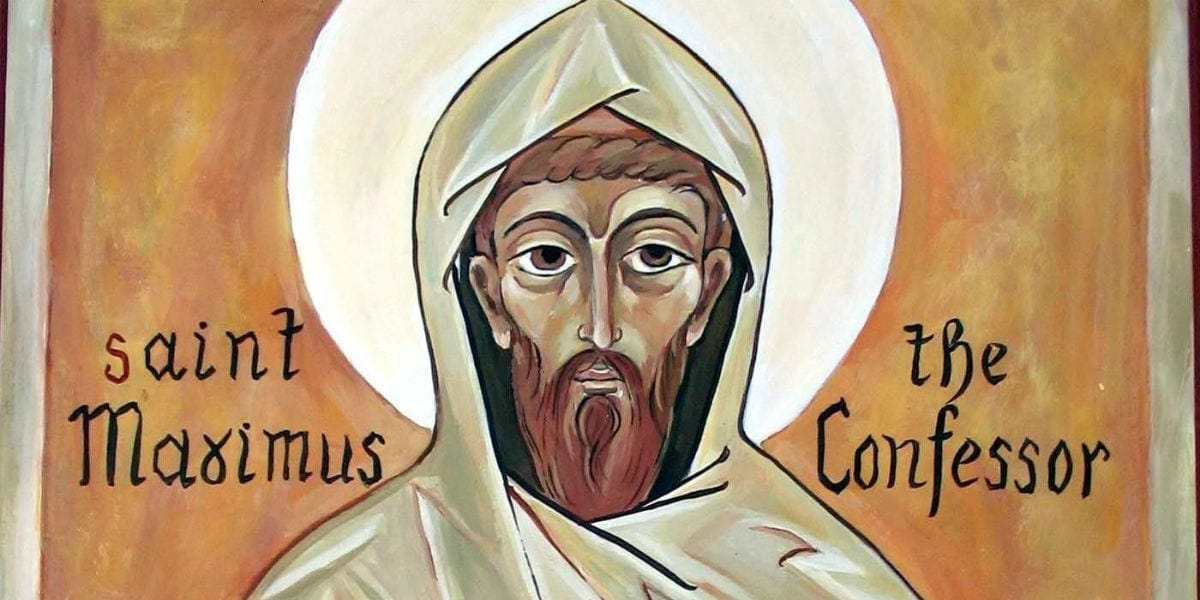
Who Was Maximus the Confessor?
Maximus was a seventh-century Byzantine theologian and monk who, at the age of 82, was tortured for refusing to endorse the Monothelite heresy, the position that Christ had only one will, as opposed to two wills (human and divine).
They cut out the old man’s tongue and mutilated his right hand so that he could no longer write or speak, convinced that in so doing they had silenced this witness to the orthodox and apostolic faith.
What they failed to realize is that a confessor of the faith confesses that faith not only with his words, but with his whole being. And so this mute old man, missing a hand, became a living word. His silence was more powerful than any letter he had written or speech he had given, confessing his and the Church’s faith in the Incarnation of God’s Son.
Maximus was exiled to present-day Georgia. Exhausted by the torture he had suffered, he died that same year.1
St. Maximus was not someone writing from the comfort of a desk, theorizing without practicing what he preached. This was a man who understood the relationship between disordered will and disordered life from the inside, at a cost so high that most of us will never fully grasp. His theological anthropology —his account of what goes wrong in the human person— was forged under an intense pressure that tested every claim he made about the human will and about the structure of sins and passions.
One of his most significant findings was that he pinpointed and identified the root of sin in his Four Hundred Chapters on Love, and gave it a name: philautia.
The Root of All Disorder: Philautia
Philautia, as Maximus describes it, corresponds to irrational self-love. It’s not selfishness in the obvious sense or the crude self-centeredness that any man can recognize and condemn in himself but something far more subtle, far more pervasive, and far more difficult to uproot precisely because it does not always present itself as a vice.
“He who drives out self-love, the mother of the passions, will with God's help easily rid himself of the rest, such as anger, irritation, rancor and so on.
But he who is dominated by self-love is overpowered by the other passions, even against his will. Self-love is the passion of attachment to the body.”
— St. Maximus the Confessor, 400 texts on Love2
The important thing to note is that, according to St. Maximus, philautia is not another sin that you need to add to the list of sins you’re currently fighting against, but the root of all other disorders, the sin that breeds all sins. This is why it’s so powerful to understand how to fight directly against it, so that you actually address the root cause of your disorders, not the symptoms.
How the Passions Are Organized
In his work, the Four Hundred Chapters on Love, St. Maximus explains that the passions are not just a random catalogue of human failures, and that they have a structure —a genealogy. At the base of that structure sits philautia, irrational self-love, specifically attachment to the body as a self-enclosed unit, as if the self were its own origin and end.
From philautia flow three general passions: gluttony, avarice, and vainglory. From those three, every other passion grows.
“Overeating and gluttony cause licentiousness. Avarice and self-esteem cause one to hate one’s neighbor. Self-love, the mother of vices, is the cause of all these things.
Self-love is an impassioned, mindless love for one’s body. Its opposite is love and self-control. A man dominated by self-love is dominated by all the passions.”
— St. Maximus the Confessor, 400 texts on Love
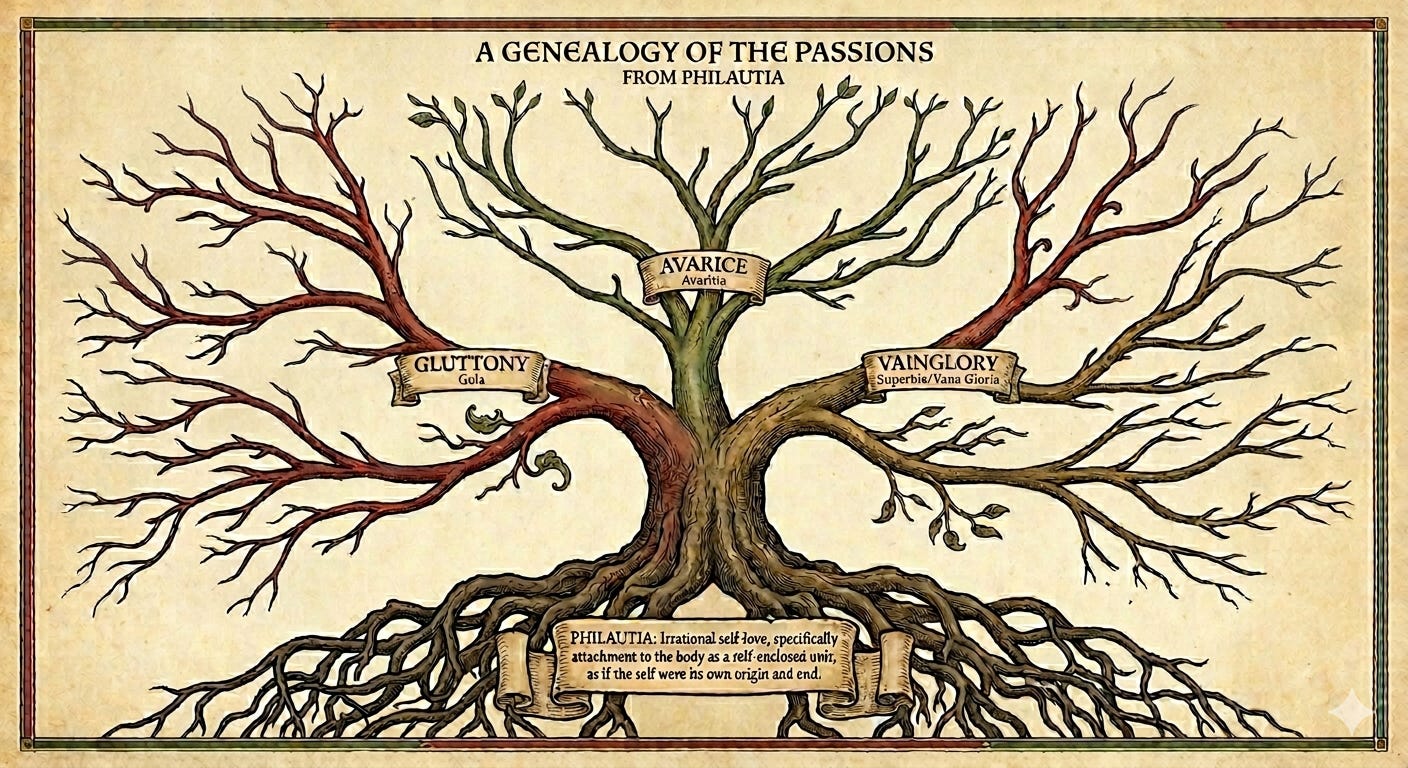
It’s important to note that Maximus does not condemn self-love altogether. Rightly ordered love of self (in God, through God, toward God) is not philautia. Philautia is the love of self as a closed system, the self that does not refer itself to anything beyond itself.
How Philautia Manifests Itself
As we said, philautia does not usually present itself as obvious selfishness, but rather as reasonable, often justifiable self-protection, legitimate comfort, earned reward, and personal preference. In practice, the manifestaion of philautia might look like this:
The man who consistently prioritizes his own comfort over the demands of his vocation. For example, the husband who chooses to watch a sports game during the weekend instead of spending time with his kids under the apparently valid pretext of needing rest or some time alone. In the accumulated small decisions that define a life, philautia presents itself as choosing our own preferences over sacrifice or service.
The man whose spiritual life is organized around what he gets from it: consolation, peace, “nice” emotions, or a sense of being right with God, rather than around love of God Himself.
The man who is generous in public and privately resentful about the cost.
The man who justifies sexual sin because it makes him feel nice, go to sleep easier, or simply comforts him somehow.
The man who has made his own peace, his own stability, his own emotional equilibrium the organizing value of his household, so that his wife and children unconsciously have to arrange themselves around his moods.
The man who mistakes the absence of obvious vice for genuine virtue, because he has never interrogated the self-referential logic that governs his daily decisions.
The man who justifies sinful or disordered actions under the pretext of health, caring for himself, “looking out for number one”, or not wanting to be taken advantage of.
All of these are rooted in philautia, as all of them are different branches of a tree that starts with a disordered love of oneself.
It’s possible that you’ve recognized yourself in one of the earlier examples, but the question that naturally arises is: if philautia generates all the other passions, what dislodges it?
Thankfully, St. Maximus doesn’t just provide us with a general diagnosis of the genealogy of sin, but he goes on to list specifically how philautia generates all other passions (lust, gluttony, etc.), and most importantly, to explain and prescribe the one movement that directly attacks philautia at its root and that will allow you to start making serious progress in breaking free from all other vices.