


There are few things more discouraging, in our pursuit of sanctity, than the guilt and hopelessness we feel after we sin. It’s like a bucket of cold water that exposes the weakness of our will and the ease with which we betray our Savior.
If you’ve been striving to purify your soul and get rid from the vices that grip you, you probably know how it goes. You make a thousand promises and start off excited and hopeful, only to lose heart after you fall, again and again.
We all fight different battles. Maybe for you it’s lust and pornography. Maybe it’s gluttony. Maybe it’s greed and avarice. Or maybe it’s some other sin you’ve confessed dozens of times. The specific sin almost doesn’t matter. What matters is that nothing seems to work. You genuinely want to change, you’re spiritually serious, you’re trying hard. But something keeps defeating you.
The good news is that you’re not the only one fighting. Throughout history, many great saints have struggled tremendously, and their struggles and solutions can show us the way forward.
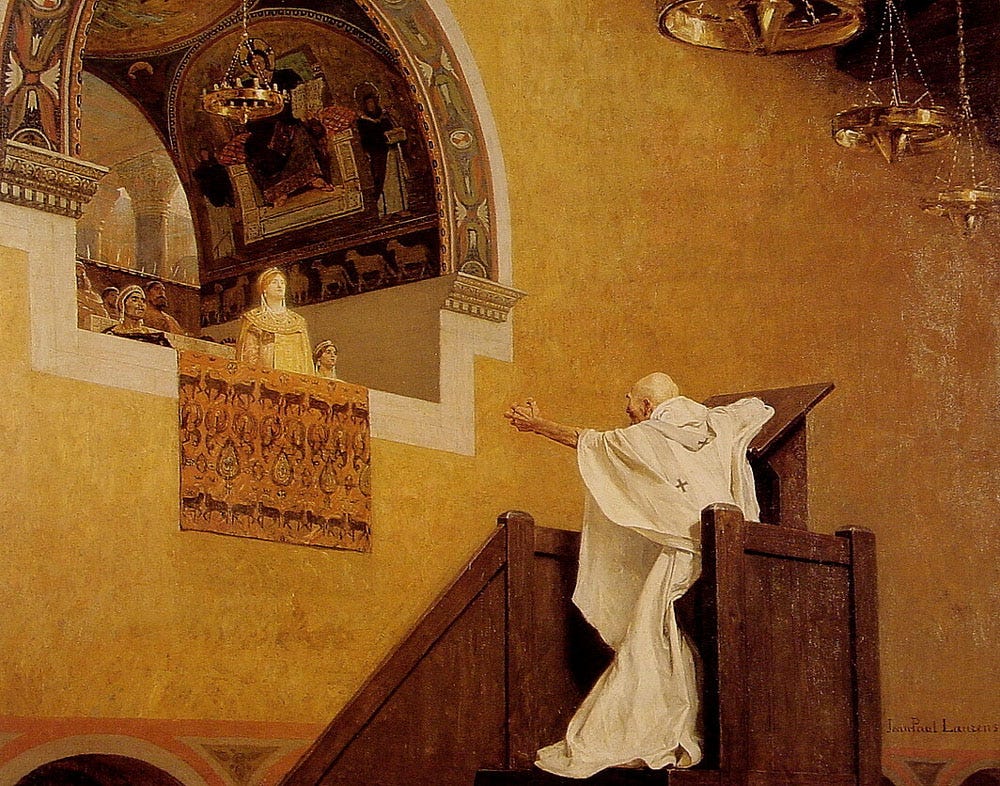
St. John Chrysostom, one of the greatest preachers in Church history, exemplifies something that modern Catholics have forgotten almost completely, and his story is key to understanding how we can finally win the battle against sin and temptation.
His example is proof that you cannot defeat sin (even less so sexual or other corporal sin) with just your mind and soul if you completely ignore the weapon that the enemy is actually using against you: your body.
St. John Chrysostom’s Strength
John Chrysostom (347-407 AD) was probably one of the most masculine Saints in history. He was the complete opposite of a modern comfortable academic intellectual. Before becoming the Archbishop of Constantinople, he spent years living as a hermit in the mountains outside Antioch, fasting, praying through the night and sleeping on the ground. His health was permanently damaged by the severity of his asceticism.
After those health issues forced him to return to Antioch, he became a priest (later a bishop), and became known for the strength with which he preached the Gospel (the name “Chrysostom” translates to something like “Golden Mouth.”) He preached to thousands, rebuked emperors without fear, confronted the wealthy openly, and refused to soften Christianity to make it palatable.
His boldness wasn’t without consequences though. St. John was exiled twice and died in exile, essentially martyred for his refusal to compromise. He was a man’s man, and a saint committed to serving Christ above everything else. His example contrasts greatly against the softness and effeminacy of the average Catholic man.
We can take a look at his years in the mountains, when he was living as a hermit, to learn a great secret that completely changes how we can understand spiritual warfare. This was something that the Desert Fathers knew, that the early Church practiced, but that we’ve completely lost.
And it will transform the way you approach the battle against temptation.
The Unbroken Body
The great insight is that Chrysostom’s spiritual strength came from the incredible bodily discipline he managed to build during his years in the mountains. In contrast, most modern men are trying to fight spiritual battles with a body that’s never been taught to obey.
He understood deeply the concept of the body as a temple for the Holy Spirit:
“But now, instead of organs, Christians must use the body to praise God.”
— St. John Chrysostom
An unbroken body is like an unbroken, untamed horse: powerful, full of potential, but completely wild. It follows its instincts, runs where it wants, stops when it wants, does whatever it feels like. It’s useless for any real work until it’s been broken, tamed, and taught to submit to the rider’s commands.
Your body is the same way. And in the modern world, the problem for most of us is that our bodies have never been taught to endure discomfort. They have never learned to be denied what they want. They have never been broken and disciplined.
Whatever appetite arises in us, we can immediately satisfy it, and thus we end up being ruled by those appetites. Because the body and the soul are inseparably connected, as long as your body rules, your soul cannot win spiritual battles.
For most men, the problem is relatively simple to identify: your body has never been told no and accepted it.
Your body wants the warm bed, so you sleep in.
Your body wants food, so you eat.
Your body wants comfort, so you avoid anything hard.
Your body wants sexual release, so you give it.
An unbroken body is a body that’s never been disciplined, never learned to suffer, never submitted to anything beyond its own desires. This concept matters greatly for spiritual warfare because —as the body and the soul are connected— the unbroken body is less prepared to resist spiritual temptation.
This is not a spiritual issue, but a physical one: your body has literally never been trained to endure denial, so it runs wild like an immature child, demanding whatever it wants and making it way more difficult for you to detach from sin.
Spiritual Solutions Are Good, But Not Enough
Accountability groups, frequent confession, praying the rosary, reading books on purity, having spiritual mentors, and memorizing Scripture verses are all amazing and very necessary practices. But I have seen firsthand (in my life and in the lives of others), that they are simply not enough.
How do we expect to impose spiritual discipline and win spiritual battles in a body that’s never been physically disciplined?
An unbroken body, when pressure comes, will default to its instincts: run wild, do what feels good, follow its appetites.
Every time sexual temptation comes, every time lust rises up, every time you feel that pull toward sin, your unbroken body is doing what unbroken bodies do: demanding what it wants and running wild when it doesn’t get it.
Spiritual warfare requires a trained body, not just a willing soul.
This is why monastic life is still built around physical disciplines: fasting, vigils, hard labor, uncomfortable sleeping conditions, exposure to elements. Because it’s only when your body has been trained to wake up when it doesn’t want to, stay hungry when it wants food, endure cold when it wants warmth and work when it wants rest that it can learn to turn away when it wants to look, resist when it wants to indulge and remain pure when it wants sexual gratification.
This is the ancient secret: physical discipline trains the body to submit, and a body that submits in small things can resist in great things.
Disciplining the body, however, is not as simple as “taking cold showers” or going to the gym 3x per week”. Thankfully, using Chrysostom’s example, we can extract a clear protocol that will break your unbroken body, strengthen it, discipline it, and make it a fortress in which the Holy Spirit can safely dwell.
Because you’re not going to overcome lust with a soft body that’s never suffered.
You’re not going to resist temptation with a comfortable body that’s never been denied.
You need to control your body, and we can —once again— use the example of St. John and other ancient hermits and ascetics to understand exactly how.