




It’s common, as you progress in the spiritual life, to feel as though you already have cleaned up the most obvious, scandalous sins. Perhaps you have already matured to the point where you can safely say that the dramatic failures of your early twenties are safely in the past, and are now committed to a life of Mass, prayer, and intellectual formation.
That is great, but that situation often comes with a feeling that something is wrong. Prayer feels like a chore and you stop reaching the depths you could access back when you were just converting. Beneath the apparently ordered surface of a serious and committed Catholic life, it is frequent for a kind of spiritual “dryness” —difficult to pinpoint or explain— to arise in your heart.
St. Bernard of Clairvaux wrote about that exact problem in 1120 AD, and he produced a diagnostic so precise that it hurts. And yes, it has to do with your phone addiction.
Who Was St. Bernard of Clairvaux?
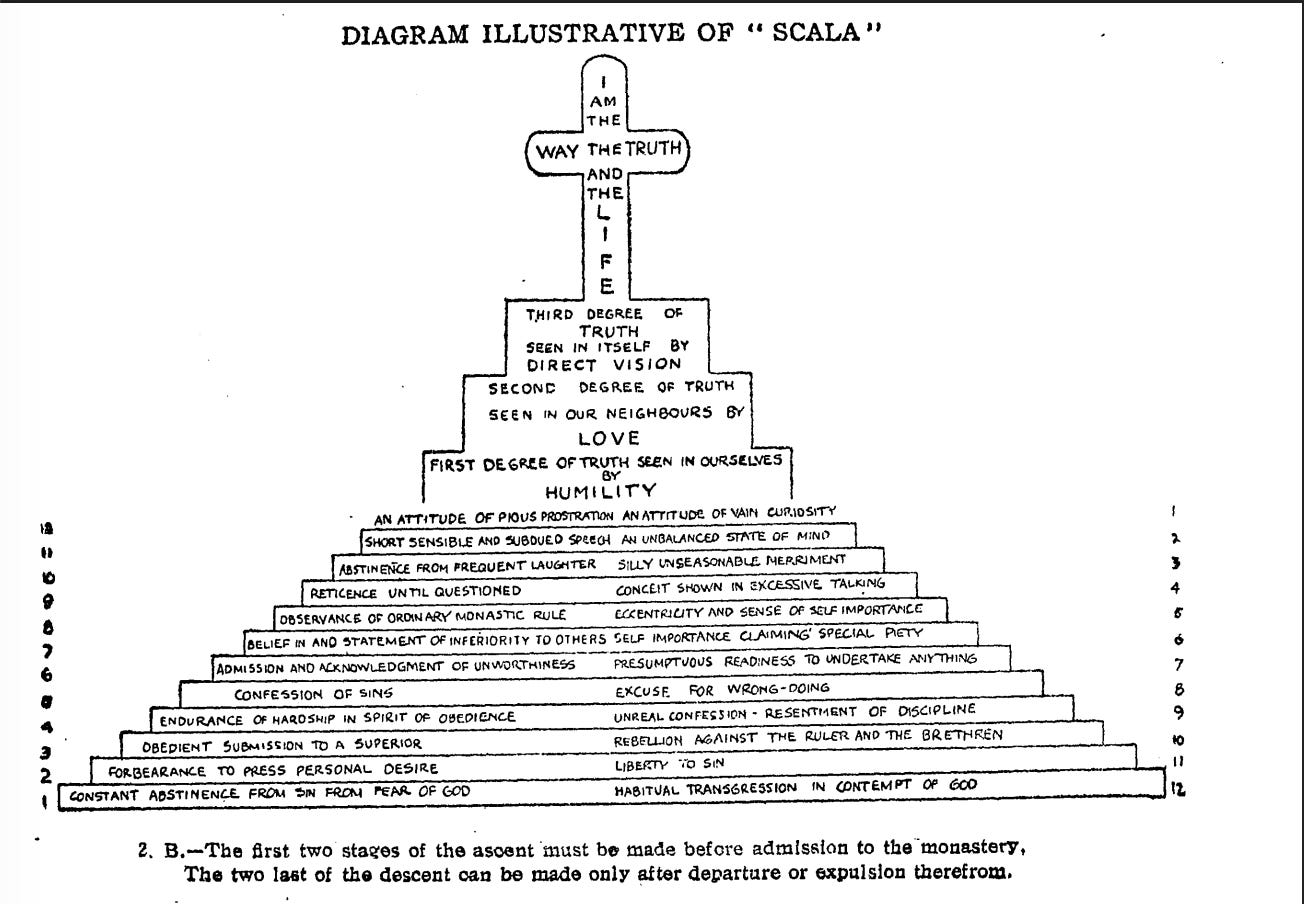
St. Bernard of Clairvaux was a twelfth-century Benedictine abbot and Doctor of the Church, author of the book De Gradibus Humilitatis et Superbiae (The Steps of Humility and Pride), in which he described the twelve descending steps from humility into pride. The book is a beautiful breakdown of how a soul can self-destruct progressively, beginning with just small, practically unnoticeable steps and ending with vice and ultimately, open revolt against The Lord.
The bottom of the ladder that St. Bernard describes is not really surprising at all: we all know that the ultimate act of pride is to reject God altogether. The top of the ladder, however, the very beginning, is surprising. St. Bernard does not place sins like lust, anger, or avarice at the beginning of the ladder, but something almost invisible instead, which most men would probably not even recognize as a vice.

The First Step Towards Pride: Curiosity
The first step of pride, according to St. Bernard, is curiositas, which is not curiosity in the regular sense but more specifically the wandering of attention away from self-knowledge and toward the observation of others.
This great Saint describes the symptoms of curiositas with careful precision:
The first degree of pride is curiosity. This you may detect by the following signs. Look at that monk, whom you have hitherto supposed to be a sensible man. He has now taken to staring about him, whether he is standing up, walking about or sitting down. He thrusts his head forward, and pricks up his ears. From his outward movements you can clearly see the inward change that he has undergone. The careless sluggishness in self-examination makes it inquisitive about others.1
It’s not that it’s wrong to have a degree of healthy curiosity about things, but rather that when left unchecked, curiositas can start leading to pride because it is a mechanism through which your attention shifts from the interior life towards the outside. Thus, the attention that should be directed toward God and toward genuine self-knowledge and examination, begins to be directed toward other people. From this small misdirection (if left unchecked), Bernard argues, the entire architecture of pride begins to build.
“Just One More Reel”
Obviously, St. Bernard in his book is describing something that in his context could mean a monk craning his neck during the Divine Office to observe his brothers or a brother looking sideways to see who was praying more fervently, who seemed to be struggling and who appeared to have more spiritual fruit than him.
For the average layman in 2026, the content has changed entirely but the mechanism remains identical. We might not be monks comparing ourselves to our brothers, but we are men deeply enslaved by curiositas. When we pick up our phones almost without noticing and waste twenty minutes being fully immersed in everything that other people are doing or saying, we are doing something structurally identical to the monks St. Bernard is talking about: we have redirected our attention away from our own interior life and toward observation of others. This will always, undeniably, lead to comparison.
St. Bernard explains exactly what happens then:
The monk who observes others instead of attending to himself will begin before long to see some as his superiors and others as his inferiors; in some he will see things to envy, in others, things to despise. The eyes have wandered and the mind soon follows.
Think about it: envy and contempt. The two characteristic emotional products of social media. And St. Bernard prophetically linked them to curiositas 900 years ago. Modern problems truly have ancient solutions.
St. Bernard goes on to explain exactly what curiositas does to the interior life, and it’s nothing short of destructive. Thankfully, he also prescribed a single counter-practice that directly reverses the damage, and it’s something you can start doing right now to avoid curiositas, reclaim your attention, and start moving forward in your spiritual life.