



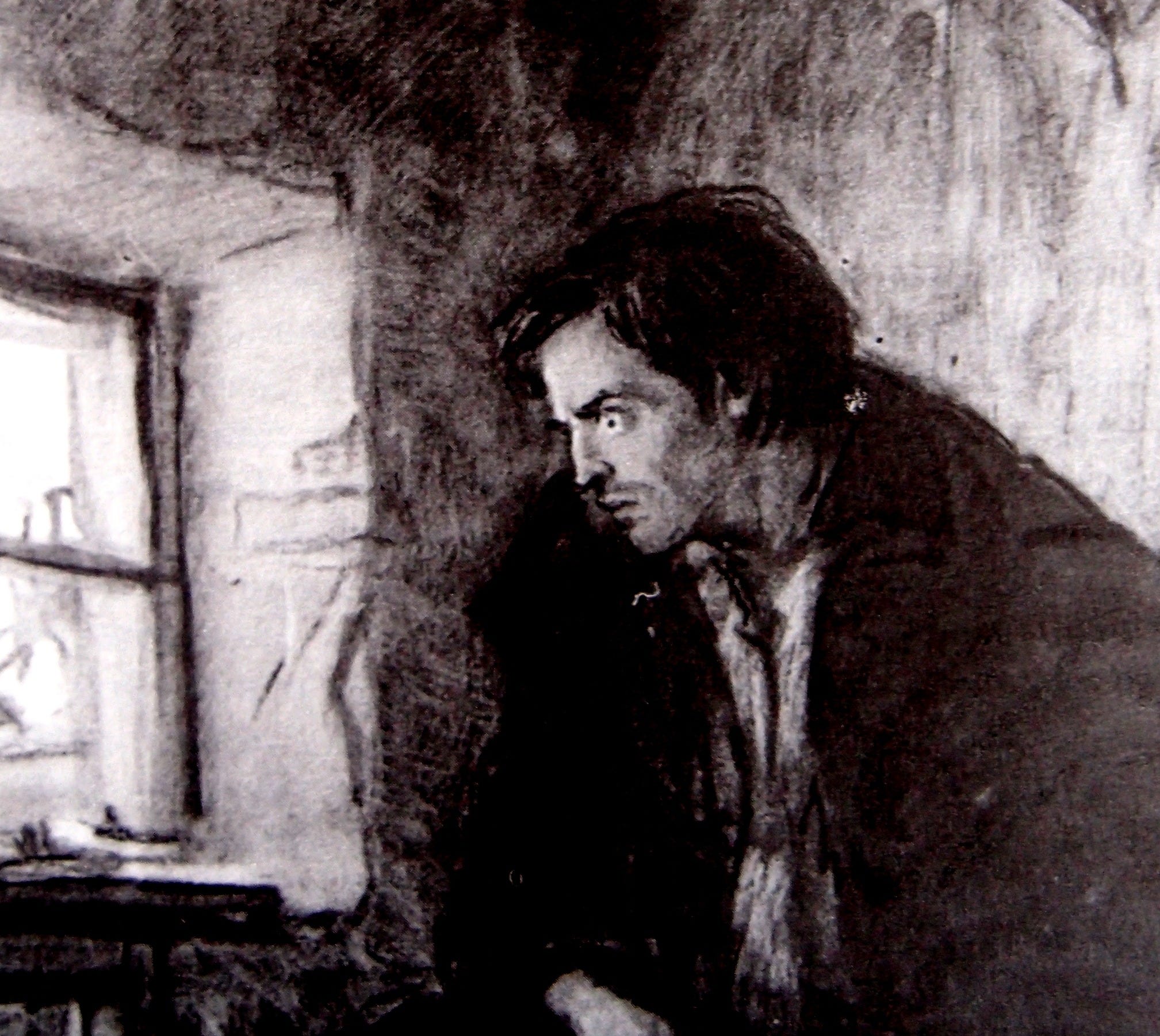
Crime and Punishment —perhaps one of the most famous novels of all time— is a book that most people know superficially: they have heard about it and have a vague sense of what it is about. Maybe if you haven’t read it or if you read it long ago, you think of it as a sort of thriller about murder and its consequences, but the book is actually much deeper than that, its main focus being not the external actions and reactions of its characters, but the psychological and spiritual exploration of how a man can collapse interiorly, and how he can find redemption.
Crime and Punishment is a deep book, full of lessons. In this article, we’ll go over just five, the ones which I consider to be most important and most eye-opening. If you haven’t read the book, you should, and hopefully this article serves to motivate you to do so.
Lesson #5: An Ideology That Justifies Evil Will Eventually Destroy the Man Who Holds It
Raskolnikov, the main character of the novel, is a brilliant but impoverished student in St. Petersburg. The book shows us how he has constructed a theory that divides humanity into two categories: ordinary men, who are bound by morality, and extraordinary men — “Napoleons” — who have the right to break laws and transgress morality it in order to fulfill a higher purpose.
“I wanted to find out something else; it was something else led me on. I wanted to find out then and quickly whether I was a louse like everybody else or a man. Whether I can step over barriers or not, whether I dare stoop to pick up or not, whether I am a trembling creature or whether I have the right...”1
Raskolnikov believes himself to be a part of the extraordinary group, and thus decides to test his theory by murdering an old predatory pawnbroker lady. The murder goes wrong from the first moment, and Dostoevsky makes sure that we realize that an evil ideology, when brought to reality, only causes chaos, turmoil, and death. The murder is sloppy, chaotic, problematic, and Raskolnikov ends up also killing the pawnbreaker’s innocent sister to eliminate her as a witness.
Of course, the lesson for us is not about murder, but more so about the specific danger of trying to justify actions that exist outside of morality, of trying to rationalize your way into breaking moral laws by convincing yourself that you serve a larger purpose that somehow excuses you. Dostoevsky’s answer is that no such theory survives the conscience, and that transgressing the law that is written in the human heart will destroy the man who tries to justify the transgression.
As Raskolnikov himself admits in Part 5, Chapter 4: “Did I murder the old woman? I murdered myself, not her! I crushed myself once for all, forever.”
Lesson #4: Only Confession Removes Guilt
It’s incredibly interesting to see how in the novel, Raskolnikov spends a long time trying to think his way through his guilt instead of addressing it directly and repenting to clear his conscience. He’s very smart —you could even say that he’s too smart for his own good—, so much so that he begins to construct intellectual counterarguments against his own conscience to avoid simply accepting the moral transgression he has committed: he reminds himself that the pawnbroker was a parasite, that he has higher purposes and was thus justified, that the suffering he feels is irrational. None of it works to clear his guilt, simply because by committing such a heinous crime, he has opened a deep wound in his soul, one that cannot be rationalized away.
The only true way that a man can find relief from guilt —and Dostoevsky understood this— is through confession.
“What are you to do?” she cried, jumping up, and her eyes that had been full of tears suddenly began to shine.
“Stand up!” (She seized him by the shoulder, he got up, looking at her almost bewildered.)
“Go at once, this very minute, stand at the cross-roads, bow down, first kiss the earth which you have defiled and then bow down to all the world and say to all men aloud, ‘I am a murderer!’ Then God will send you life again.
Will you go, will you go?” she asked him, trembling all over, snatching his two hands, squeezing them tight in hers and gazing at him with eyes full of fire.
Only by explicitly naming the evil that was done, to another person, in full, can the healing process begin. Throughout the novel Raskolnikov makes a series of partial disclosures, as if he was “dipping his toe” in the water of confession. But no hint, no “near-confession”, no partial disclosure relieves him. It’s only when he confesses fully, first to Sonya and eventually to the authorities, that he can finally begin to heal.