



It’s a terrible tragedy —and an undeniable truth— that most men feel deeply lonely. Even when surrounded by kind, welcoming people, most men share a quiet and yet fundamental notion of being alone and unknown. It’s as if something inside of us always remained carefully hidden, regardless of how rich our social life might look like on the outside.
Too often, this feeling of solitude becomes so sustained that we start assuming that it’s just an inescapable condition of being a man in a fallen world. We start to believe and accept that we will always feel, on some level, alone and misunderstood. And while I’m not going to argue against the very real struggles that we men face, it’s important to understand that frequently, the specific sentiment of social isolation is made worse —and even, in some cases, caused— by sexual sin.
This is not, however, mainly an article about sexual sin (I’ll link a couple of those at the end of this article), it is an article about the specific effects that sexual sin has on a man’s capacity for authentic human community, which is a consequence that is rarely discussed. Most writings on chastity focus on the individual, but there is a great saint who chose to address something the individual usually fails to recognize: the social cost of sexual immorality.
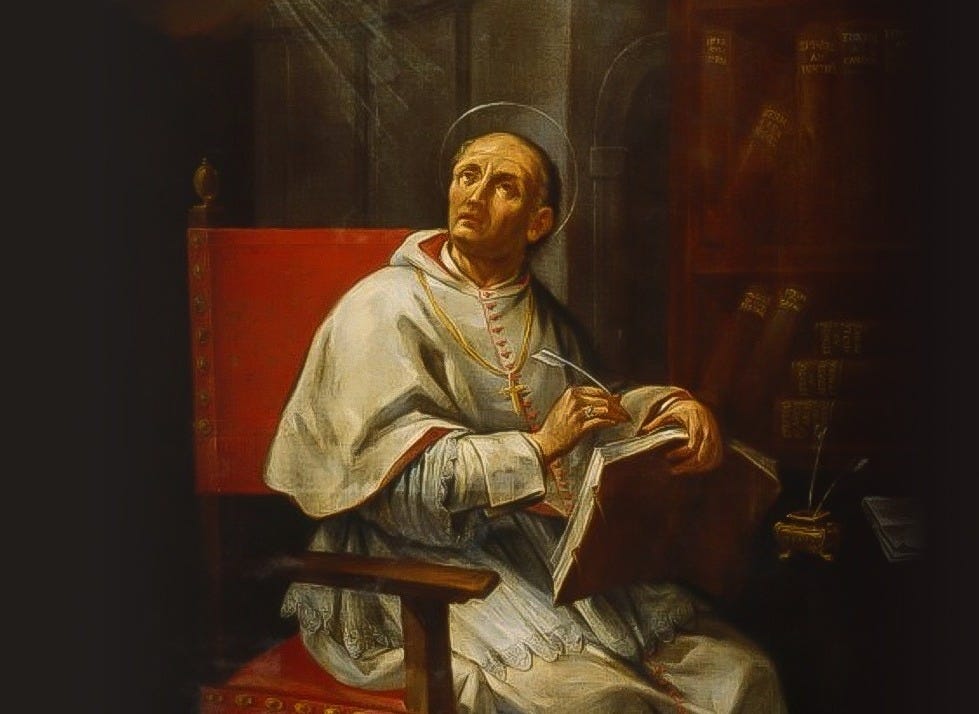
Who Was Peter Damian?
Saint Peter Damian was an eleventh-century Benedictine monk who later became Cardinal Bishop of Ostia. On September 27, 1828, Pope Leo XII officially declared him a Doctor of the Church. One of his most important works is the Liber Gomorrhianus, which he wrote around 1049 AD and addressed directly to Pope Leo IX. This seemingly simple action actually required a lot of personal courage, because the text named and exposed specific forms of clerical sexual disorder at a time when doing so could be dangerous.
While the text is widely used in culture-war contexts to speak against homosexuality (both within and without the clergy), some of its most relevant anthropological arguments are largely ignored or unknown. However, the structural argument which Damian makes about what sexual sin does to the interior life of a believer and therefore to the possibility of genuine community and fraternity is, in my opinion, extremely powerful, and worth knowing.

How Sexual Sin Leads to Isolation
Sexual sin has a particularity that makes it different from all other sins: it is by nature uniquely self-enclosing among the passions. Other sins like anger, avarice or pride are often visible to others and are thus somewhat subjected to social control or approval. Sexual sin, in contrast, usually operates in secrecy. It requires concealment to survive, and that concealment over time creates within a man an entire interior region that is systematically hidden from everyone around him. This is not merely a secret that you possess and keep private, but a completely secret “self”, another you that is completely different to the you that your community, family, or friends know and love.
This vice […] defiles in secrecy and dishonors in public. She gnaws the conscience like worms, burns the flesh like a fire. She fears to be exposed, to come out in public, to be known by others.
— St. Peter Damian, Book of Gomorrah, Chapter XVII.
The consequence that naturally follows from this fragmentation of your identity is that you slowly start to lose the ability for authentic human community, because it requires an interior transparency that you now feel you can’t afford to have (because they would know the other you who is deeply attached to sexual sin).
The effects of sexual sin, as you can see, are terrifying, and reach much deeper than most people realize. Not only does it cause great harm socially, isolating you and filling you with shame, but it also destroys you internally:
This plague removes the foundation of faith, enervates the strength of hope, breaks the tie of charity, destroys justice, undermines fortitude, banishes temperance, and blunts the sharpness of prudence. And what more shall I say? Since indeed it expels every cornerstone of the virtues from the court of the human heart, it also, as if the bolts of the doors have been removed, introduces every barbarity of the vices.
— St. Peter Damian, Book of Gomorrah, Chapter XVII.
Damian is clear: sexual immorality expels the virtues from your heart and opens it up to every barbarity of the vices. Thus, if your faith has been undermined, your hope weakened, your charity broken, and your prudence blunted by sexual immorality, you don’t have just a private problem, but a structural one that leads to isolation and the feeling of being unknown. These are the social consequences of lust’s destruction of the interior life.
When a man is consumed by sexual immorality, he stops being capable of developing genuine relationships, because any authentic relationship requires the mutual knowledge of each other’s interior.
The goal of this article is not to make you despair, however. Quite the opposite. Damian’s Book of Gomorrah has a more positive, practical second half, in which he provides a step-by-step protocol to quit sexual immorality and thus begin to thrive not just interiorly, but socially too.