



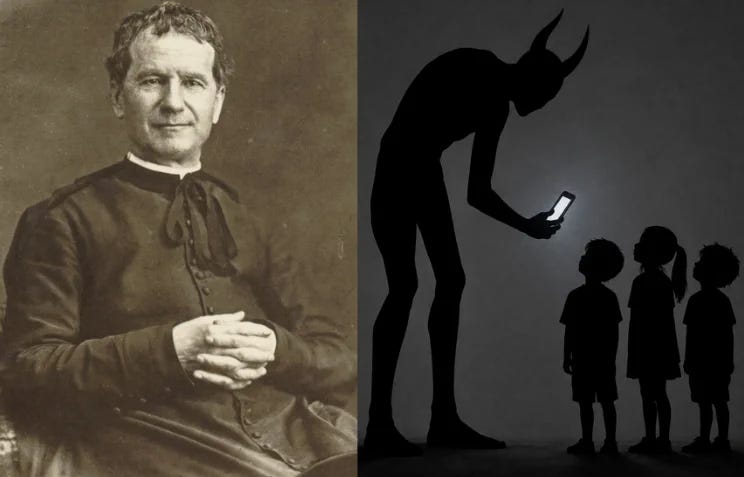
I recently came across a viral post on Instagram that caught my attention:
At first, I was skeptical. Social media is flooded with made-up stories carefully crafted to catch your attention, and it’s usually the more incredible ones —regardless of their veracity— that end up getting viral traction. This seemed like a perfect fake news story to get likes, comments, and reshares.
Imagine my surprise when, after actually doing the research to find out whether or not St. John Bosco ever mentioned such a vision, I found the original text, which verifies the claim of the earlier post.
It’s truly striking how often great minds who lived long before our time manage to predict, in one way or another, future phenomena. Anyone who reads St. John Bosco’s account of the magic lantern dream will immediately notice the uncanny similarities between his vision and our time.
His account of this dream is found in The biographical memoirs of Saint John Bosco, Volume VIII, p.69:
Dear boys, I dreamed that I was in church. It was packed with boys, but only a few were going to Holy Communion.
Near the altar rail a lanky horned individual, black as coal, was showing magic slide pictures.
Enticed by them, the boys forgot everything else. As a result, only a few went to Holy Communion.
Do you understand what this means, my children?
It means that the devil does his utmost to distract you in church in order to keep you away from the sacraments. Some boys are so foolish as to pay attention to him.1
Don Bosco’s Dream, Unpacked
There is a lot of depth in this great Saint’s vision, and a lot of things to unpack that might not be evident at first glance. This is all, of course, my interpretation, so feel free to dispute it in the comments:
The setting is a church. Let’s imagine for a second that Don Bosco’s vision was actually prophetic, and that God was showing him glimpses of a spiritual battle that would be fought in the future. The setting that God chooses is a church, and the specific moment when the vision happens is when the Eucharist is being offered. This is important. It is a warning: the main purpose of the lantern is not to make us lack focus at work or even in our family life (as we often think), but to make us approach our faith unintentionally. To do the bare minimum and to be absent in mind and soul even when our bodies are present at church. This is also —I believe— why the dark figure is near the altar, and not somewhere else entirely. He’s close enough so that the boys feel like they’re fulfilling their spiritual duties and thus lower their guards.
The content is not evil in and of itself. Perhaps we already know that we need to avoid provocative or immoral content online, and have established clear boundaries to avoid consuming content that is outright evil. But notice that Bosco never tells us what the pictures showed. The text doesn’t say they were evil, only that they held the boys’ attention. What that means for us is that even neutral or seemingly good content can become a problem, if we let it distract us from the most important thing: God. When you cannot stop consuming even “helpful” content, when you’re always listening to business podcasts, or even watching debates and apologetic videos too frequently, you might feel as though you’re safe from the lantern (because you’re “learning”), but you’re actually still letting it distract you from spending time in prayer and intimacy with the Lord.
The effect is forgetfulness. The lantern doesn’t make the boys resent or turn against God. They aren’t filled with pride or envy. They simply forget why they came. Is this not the story of our time? We are losing our capacity to focus, we are losing our ability to remember, and we are losing sight of what’s truly important. When your attention goes toward the lantern, it doesn’t go toward the Lord.
The goal is absence. Nobody in Don Bosco’s dream commits a dramatic, scandalous sin. And often that is not even the devil’s aim. In this case, all he needs is for the boys to stay in their places and not go to the sacraments. As long as they are distracted, he knows they fail to grow in holiness. For us, this is particularly relevant as well: many devout Catholics do not really fall for the scandalous sins anymore, and are thus easily swayed into a dangerous complacency in which they inhabit a sort of limbo between sin and virtue, not falling drastically toward the abyss but never climbing toward virtue.
You can choose to divert your gaze. St. John Bosco writes that “some boys” are foolish enough to pay attention to the figure, thereby implying that letting ourselves be distracted by the lantern is a conscious choice. This is key, because it reinforces the fact that we have the freedom to choose where our focus goes: toward the lantern, or toward the Lord.
This great saint probably didn’t know how relevant his dream would become well over a century after his death, but it’s quite difficult to read his vision and not believe that he was seeing what would become one of the defining spiritual battles of the 21st century: the battle for our attention.
After describing his dream, St. John Bosco goes on to explain, in two sentences, what the solution to the problem of distraction is, and it’s incredibly simple, and yet completely effective: