


One of the most frequent struggles modern men face is inconsistency. Most of us have started and quit more things than we can count: training programs, prayer routines, diets, business ideas. The same pattern repeats incessantly: we begin full of motivation, and then slowly, we start to lose our willpower to continue. Doubt creeps in, and it starts to become difficult —or rather, impossible— to find the strength and discipline to continue.
The reason we quit isn’t because we lack motivation, or even discipline; it’s because of a vice that St. Benedict identified almost 1,500 years ago: acedia.
The magisterium defines acedia as:
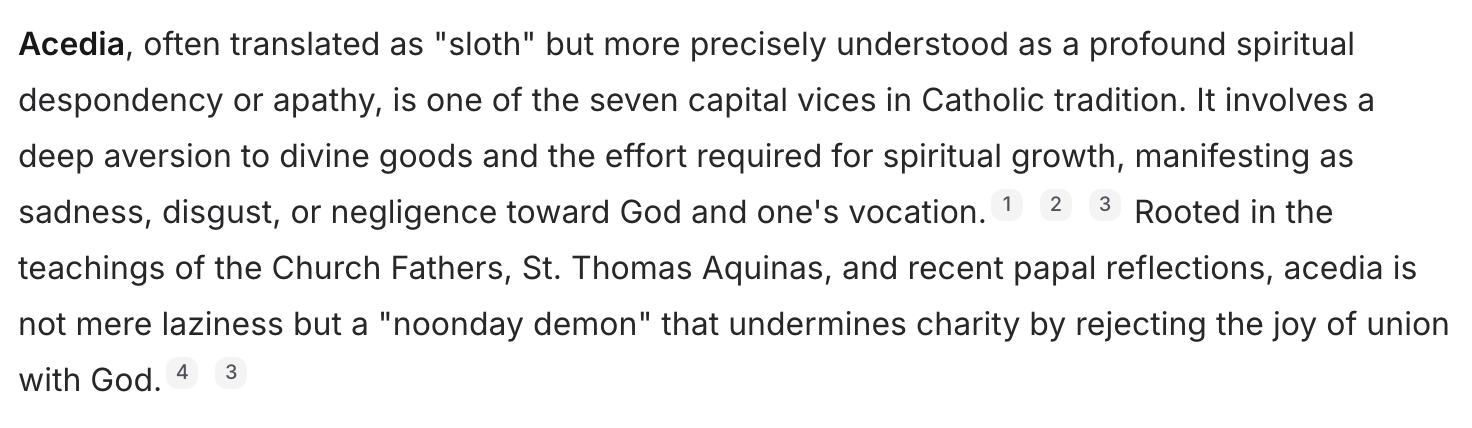
Interestingly, in Eastern Christian tradition, acedia (translated from the Greek akēdia, "lack of care") appears among the eight evil logismoi, and signifies sluggishness, depression, sadness, or a feeling of taedium. It’s a deep apathy about spiritual things that drives you to seek escape and distraction.
St. Benedict understood that in most cases, what leads to us giving up too soon has its roots in the logismoi of acedia, manifesting as a restlessness and lack of stability that makes it difficult to persevere and be disciplined. Thankfully, he found a way to combat this vice, and we can do the same.
St. Benedict’s Vow of Stability
There was a massive problem among monks in sixth-century Europe. They were drifting from monastery to monastery, always searching for the “right” community, and the most comfortable life. When prayer got difficult, they’d move. When conflicts arose, they’d leave. When routine became too boring, they’d seek something more exciting. They were becoming spiritual tourists, picking and choosing different monastic lifestyles without ever committing.
St. Benedict noticed this, and he came up with a radical —but quite effective—solution: the vow of stability. It was a vow of absolute commitment. If a monk entered his monastery, he was required to commit to that place for life. He was required to accept that he would be living at the same location, with the same brothers, living the same routine every day, until death. There was no monastery shopping, no escaping when things got hard. It was a lifelong commitment, taken in an effort to avoid the dangers of the shiny object syndrome that was plaguing many monks at the time.
Benedict was fighting something more dangerous than mere geographic instability. He understood that moving from place to place was but a symptom of a deeper problem, that of a restless heart that believes the next thing will finally work, or that somewhere else is where you’ll find peace. He understood that restlessness made it incredibly difficult to explore the depths of the soul, achieve any sort of mastery, and get closer to holiness.
You cannot grow deep roots if you’re constantly transplanting yourself. You cannot become excellent if you abandon things when they stop being easy. The vow of stability was Benedict’s weapon against spiritual wandering. And fifteen centuries later, it is just as relevant for us, because even if we’re not monks wandering from monastery to monastery, we are being attacked by the same kind of acedia that paralyzes us.
Acedia in the Modern Age
There are too many options nowadays. In a globalized, digital world, we can engineer basically everything we want about our lives.
If you’re one of the lucky ones born in a developed nation, you have an array of endless opportunities, options, and choices regarding how to live your life. You can choose what to eat, where and how to work, what to believe in, who to surround yourself with. We are no longer limited by geography and there are fewer and fewer roots keeping us tied to a place, a job, a group of people, a routine. That is in some ways a good thing, but the negative side of it is that it’s very difficult to commit to anything over the long term when there always seems to be a better option, a brighter object, a happier place.
This restlessness manifests across all areas. In spiritual practices, like when you want to start praying the rosary daily and then quit after two weeks. In fitness, when you pay for a full year at the gym only to quit two months in. In your career, when you are constantly trying to find a new job. In your love life, when you break up at the first sign of trouble, always looking for a newer, more exciting relationship. In your skills, when you want to learn something new and buy a course to never put it into practice.
The pattern is exactly the same, over and over again: initial enthusiasm → routine → boredom → quitting, right when the real work is supposed to begin.
The Devastating Cost of Instability
This instability might seem like a small matter, but if you think about it, the consequences of this failure to commit are dire:
Spiritually, you never build your faith on solid ground, and it becomes dependent on your feelings. This makes it shallow and weak, liable to crumbling when suffering comes.
Professionally, you never become excellent, as you’re always having to learn and adjust to new jobs and environments. By switching all the time, you miss the opportunity for compound growth to happen.
Relationally, you will never form strong friendships, you’ll have trouble committing to a woman for life, and your family won’t be able to depend on you, as you’ll be erratic and unreliable.
Psychologically, you’ll be a victim of anxiety, always thinking you’re missing out on something better, and slowly starting to identify as someone who just can’t finish what he starts.
Materially, even, you’ll waste money and opportunities jumping from one offer to the next, choosing the newest “investment” that comes, never able to settle and build a solid financial foundation.
This restlessness has a terrible compounding effect, in which instability in one area bleeds into all areas until you become “the guy that tries everything but commits to nothing.”
To see solid progress at anything, a long-term commitment is an absolute requirement. Without the preexisting promise that you’ll work through the difficulties, and work to solve the problems that will naturally arise, you will never move past the emotionally exciting stage of a relationship, a business, or the spiritual life, into the more difficult but more meaningful slow, daily work that truly moves you forward.
We have to learn how to stop being restless. That’s how we can finally commit to something and truly grow. Thankfully, the wisdom of St. Benedict can guide us.