



There was recently a large masculinity congress taking place in a neighboring country, and it was extremely popular. They did an amazing job promoting the event on social media, got some speakers of great renown, and successfully welcomed thousands of participants.
And even though I believe the congress was —in general— a net positive, there were some things about it that bothered me somewhat, which prompted me to write this article. Now, I didn’t attend the event, so I’m writing this based on what I heard and saw on social media. Take it with a grain of salt however, because I might be missing some information.
The Manly Maxim #3
“Manly men make manly men.”
— Stephen Mansfield, Mansfields Book of Manly Men
One of the first books I ever read about masculinity (and still one of my favorites), is Mansfields Book of Manly Men, by Stephen Mansfield. In it, the author goes over what he calls the 5 Manly Maxims, five principles of masculinity that all men should live by.
Particularly relevant for this article is Manly Maxim #3: Manly men make manly men. The congress I mentioned at the beginning of this article had —in my opinion— some glaring problems, the main one being that they had female speakers presenting as part of the lineup of speakers. Bear in mind, this was explicitly promoted as a masculinity congress, for men and by men.
Look, I think we’re past the time when we must maintain a subtle feminist undertone that denies the obvious differences between men and women, so I’ll just state my issue plainly: I believe women will always be inadequate teachers of masculinity. Masculinity needs to be transmitted man to man.
This is in no way an attack on those single mothers, for example, who have been forced to raise sons on their own. They surely do their best and their effort and sacrifice is admirable. But men can only really learn how to be men from other men. If this wasn’t the case that would mean men and women are interchangeable, and we know this isn’t the case. Women can teach men a lot of things (moms are the best), but when it comes to masculinity, there are certain gender specific things that only a father can teach, just like only a mother can guide her daughter into womanhood through the particular challenges of growing up as a woman.
Feminism has permeated the very air we breathe, so much so that even seemingly countercultural initiatives like this masculinity congress play a part in furthering the lie of absolute equality between the sexes. When you have women teaching men about masculinity, you are accepting the premise that it really doesn’t matter whether you are a man or a woman, because all knowledge is learnable, ignoring the very real experiential wisdom that is unique to both men and women.
I’m reminded of a scene in Fight Club that reflects how I felt watching the highlights from this masculinity congress:
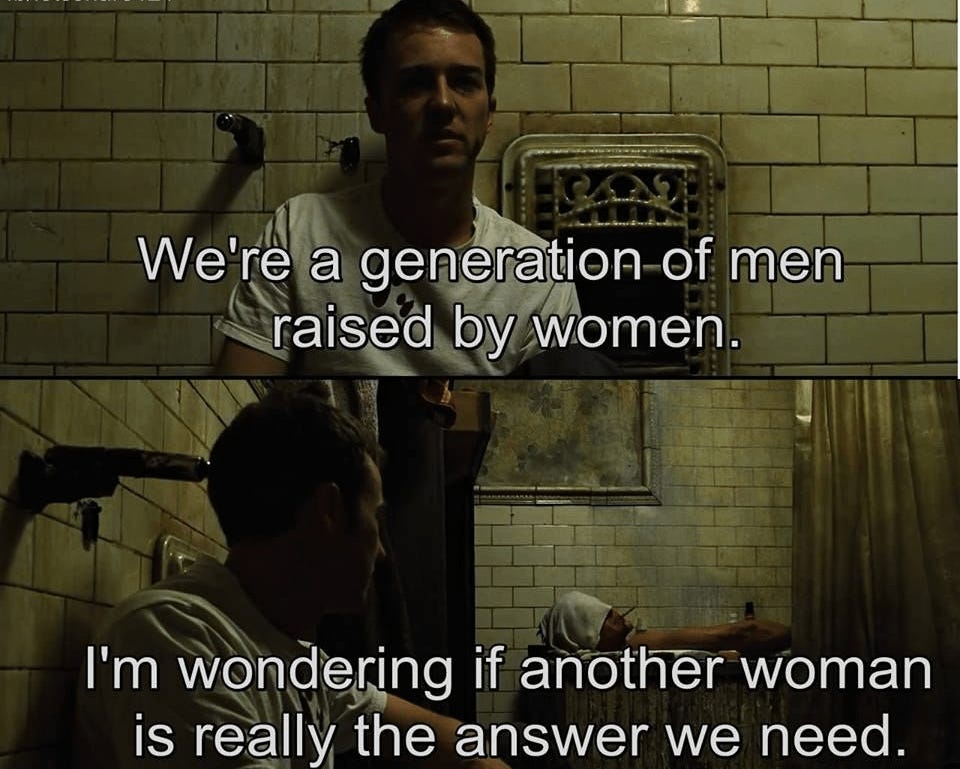
Our young men are desperate for strong masculine leadership, and for a return to the God-given order in which men bear the burden of headship at home and in society. We need to guide one another, support one another, be present in raising our sons, and help those younger than us to navigate the stormy waters of masculine development. We need to start reclaiming our authority over the transmission of manhood, not as an act of hatred against women, but as a necessary recognition that it is us who can and should teach men to act like men, not them, no matter how well intentioned women might be.
What Only Fathers Can Transmit
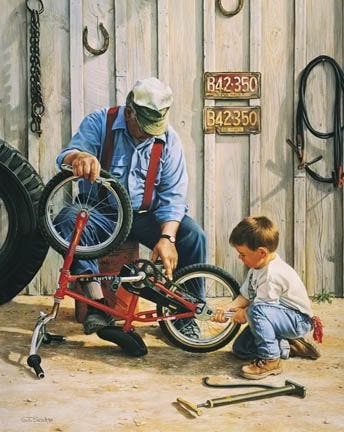
A father, or any older man who takes up the task of forming other men seriously, passes on things that cannot be reduced to mere information. He teaches masculinity by example, wielding authority that only comes with firsthand experience. He can show a boy how to carry physical risk and danger without being ruled by fear because he has been there and done exactly that. He can teach a boy how to absorb correction humbly from another man without collapsing into resentment or wounded pride, because he has been corrected himself directly, man to boy, and understands how it feels. He can teach him how to compete and lose without bitterness, how to channel aggression into protection rather than domination, how to endure discomfort in silence rather than narrate it because he has done all of that himself. None of this arrives through a course on masculinity. It arrives through example, often without either the man or the boy fully realizing the lesson is taking place.
This is why the transmission has to happen man to man: what is being passed on is not just information. A woman can describe every one of these things with complete accuracy. But she cannot induct a boy into them, because induction is not merely a transfer of facts and knowledge, but a transfer of proven capacity, verified through shared trial. The message matters, of course, but the messenger matters, in many cases, much more.
The Philosophical Foundation
The deeper problem in the congress's choice is not really about whether the female speakers said true things, because they probably did. The error is in treating masculinity as a body of information that can be transmitted by anyone qualified to speak about it, rather than as a deeper formation that happens through relationship, example, and shared trial between men. Information can come from any credible source, but formation requires an initiator who has walked the path himself.
This is, for example, why the Church has always ordained men to the priesthood through apostolic succession. She understands the need of a direct, embodied transmission from man to man, stretching back to Christ and the apostles. This is diametrically opposed to what happens in other Christian denominations that have been permeated by relativism and feminism, in which formation is seen as merely as a set of theological facts that any sufficiently informed person could convey. The same logic, on a natural level, governs masculine formation. You cannot fully induct someone into a state you have not occupied yourself.
Conclusion
The organizers of the event were surely well-intentioned, and they recognized a real problem: men are starving for formation, for answers, for fraternity. They failed, however, in purging the subtle feminist ideologies we have all absorbed from their congress, by thinking that masculinity could be transmitted by anyone qualified to speak about it, when the entire structure of formation requires the speaker himself to be a man who has walked the path.
If the renewal of masculinity is going to be real, it has to be rebuilt on the actual mechanism by which masculinity has always been transmitted: men, present to other men, modeling and demanding and forming what they themselves were once formed in. This requires standing against the cultural forces that will instantly condemn you for creating spaces that are exclusively male, but it’s worth it and necessary.
Only when more men muster up the courage to speak with their chests, and boldly take up the weight of masculine leadership will our culture produce more virtuous men who can guide society towards a brighter day, ordered under Christ and aimed towards eternity.
Ad Maiora Nati Sumus,
Juan


Thank you for reading!
If you enjoyed this post and could leave a like or comment it would be greatly appreciated, as it will help my work reach more people.
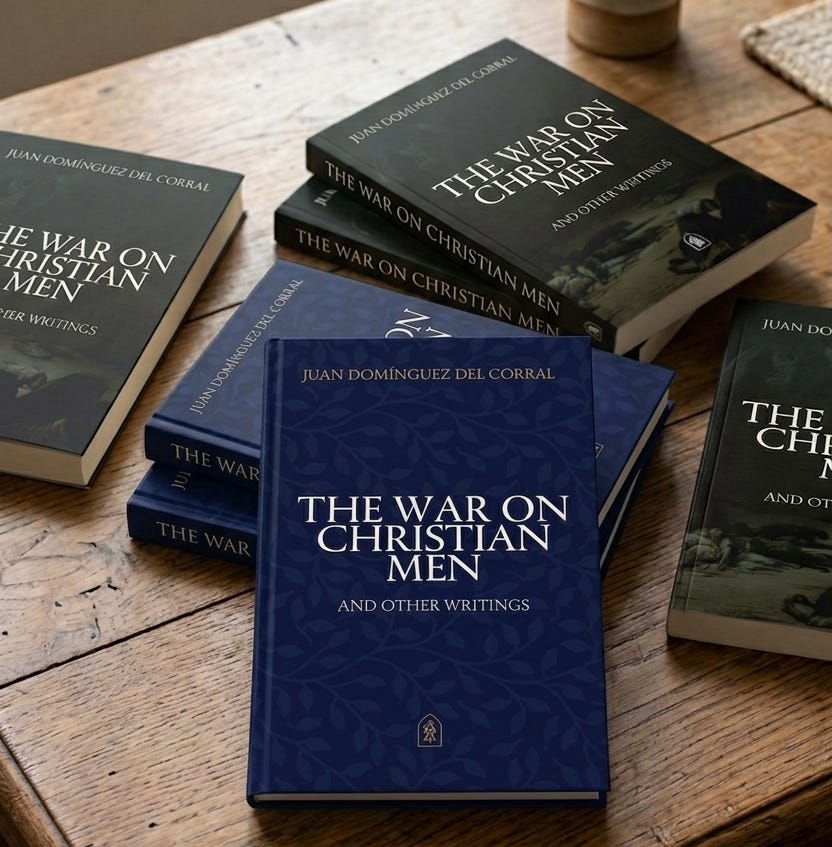
Also, if you liked this article, you’ll love my book.
Definitely the biggest thing holding back young men today. Lack of responsibility and don’t know how to be men. It’s not their fault - they didn’t have good role models.
My favorite "Making Men" story was from when I was a Scoutmaster in Southern Arizona. Our troop was at a camporee and one of the events was a Dutch oven cookoff. Fifteen minutes before entrees were due to the judges, my scouts asked me, "Mr. Devlin, what are we doing for the Dutch oven cookoff?" I replied, "Since you didn't plan anything or get around to starting the fire, I guess we're losing."
The boys were devastated so I asked if they wanted to learn how to cook with Dutch ovens. They never lost another cooking competition and one of those boys, my son, is now a phenomenal outdoor cook. He made a brisket for Father's Day that just melted in my mouth.