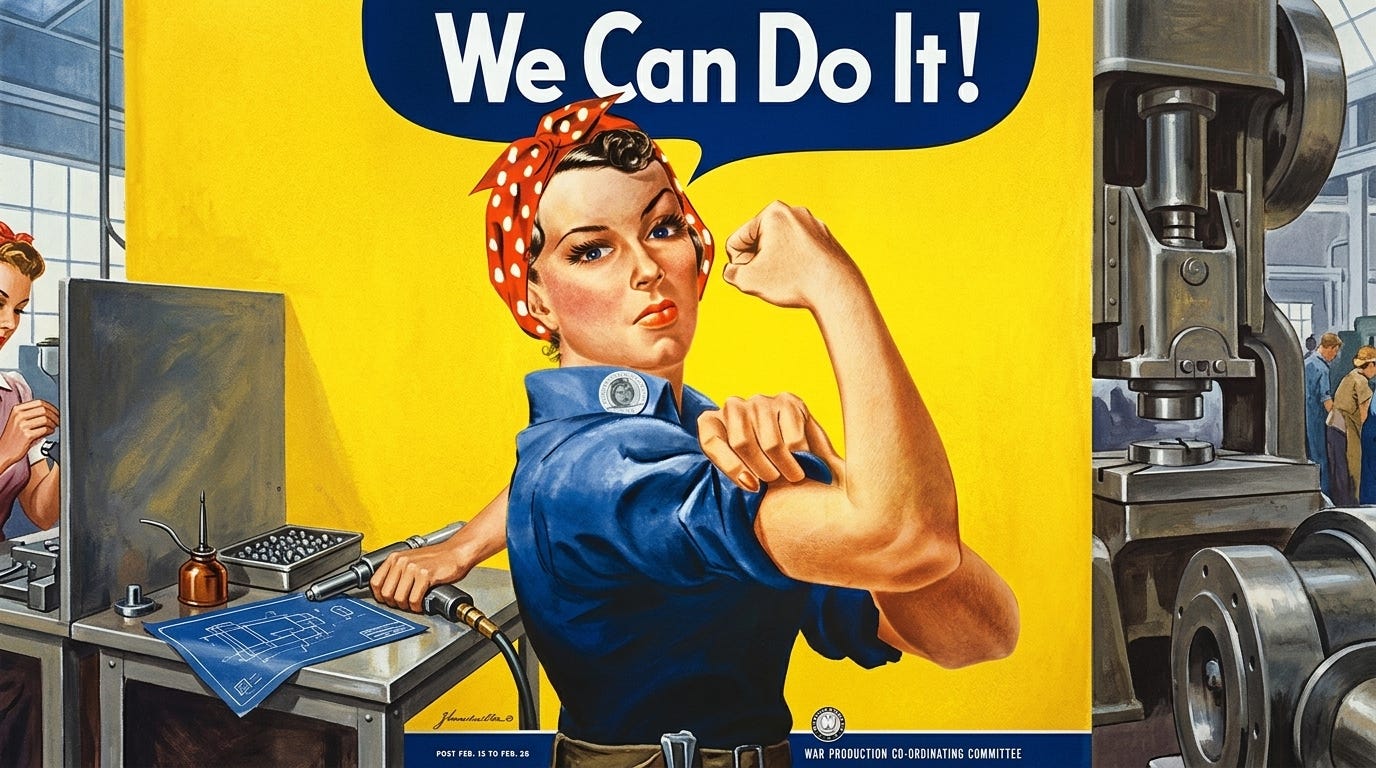
A few months ago, I posted an article titled “5 Ways in Which You’ve Internalized Feminism”. I don’t think it’s my finest work, but I’ll link it here in case you want to read it anyway:

The article was a simple list of ways in which feminist ideas have permeated most people’s worldview, to the point where most of us unwillingly use feminist thinking patterns to evaluate our decisions and our culture:
Even the man who believes himself most resistant to feminist ideology has likely internalized some of its premises without ever noticing the moment they moved in.
— From the aforementioned article.
As it is my custom, I posted a carrousel of the article to Instagram, and was surprised at the controversy it sparked over there. Most specifically, a girl who I later knew was a follower (but unfollowed my account due to this post), crashed out in the comments section:
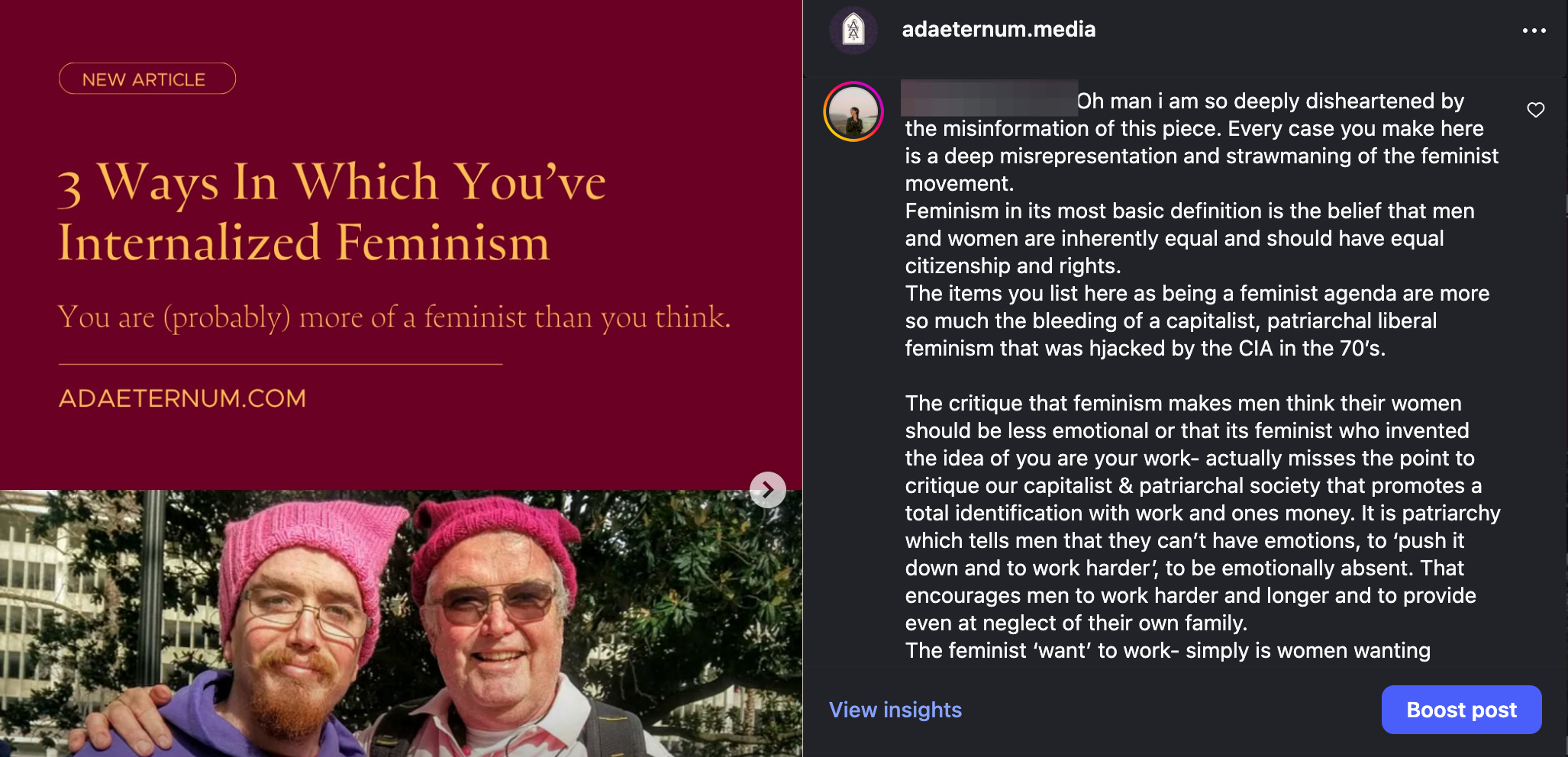
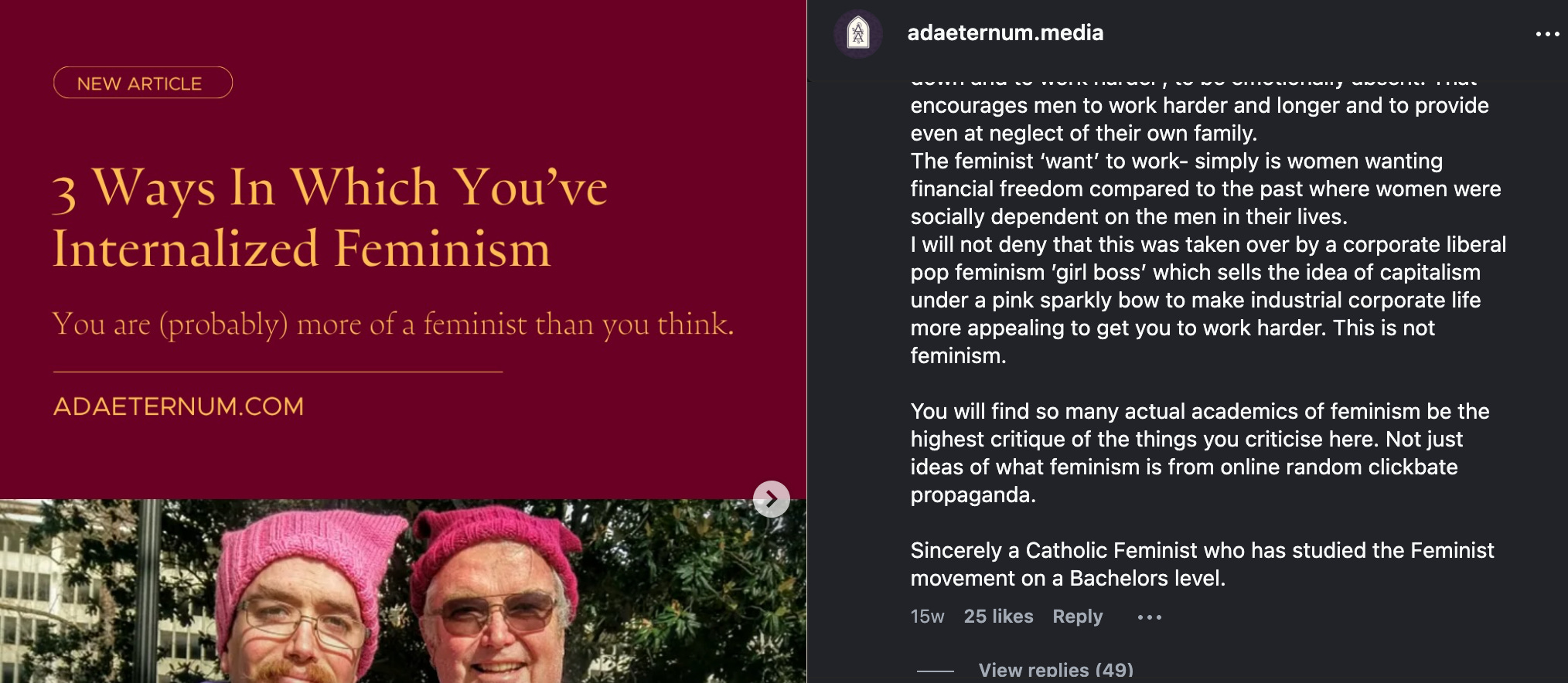
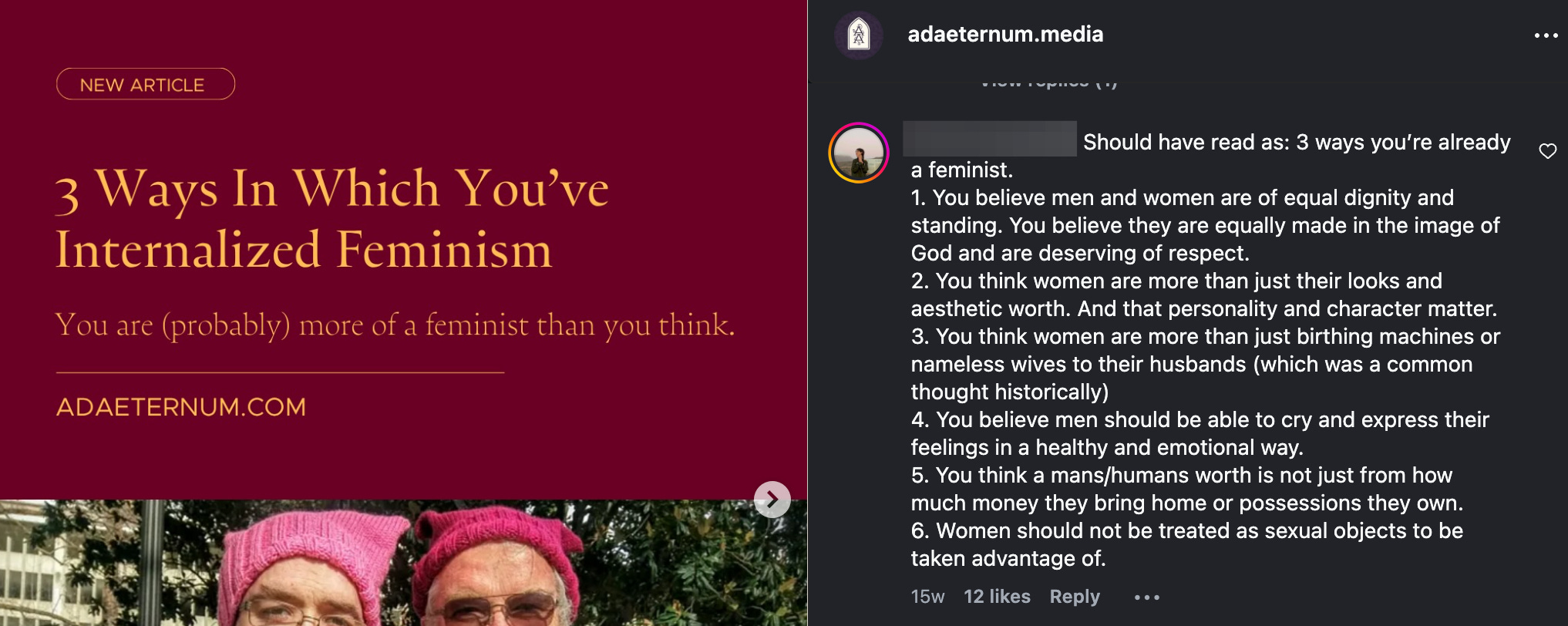
After reading her essay and realizing that she actually didn’t understand or read the post, the one thing that prompted me to write an article was her self-proclamation as a “Catholic Feminist”. It’s okay to be wrong, but I draw the line at trying to adapt the One True Faith to fit your personal ideology. This won’t be a “rebuttal” article, as I won’t go over her answer, and in fact, we’ll stop talking about her and my Instagram post right now.
This will more so be a short philosophical exploration of why Catholicism and Feminism (and every other “—ism”) are fundamentally incompatible.
“Catholic Feminist” is a Contradiction
Even if we were to concede that the original feminist movement had goals that were in some ways aligned with Catholic teaching (by reinforcing the dignity of women, for example), it’s undeniable that both belief systems cannot truly coexist beyond a mere surface agreement, because even where they —almost accidentally— point to the same practical conclusions, they proceed from radically different motivations.
Catholicism recognizes every single individual’s intrinsic worth, regardless of their age, sex, race, or circumstances, because we are all made in God’s image. Feminism, while it claims to do the same, has as its foundation the critical theory framework of “oppressors vs. oppressed”, not of equal intrinsic dignity but of recovering dignity that had been stolen at the hands of “the other group”, in this case, men.
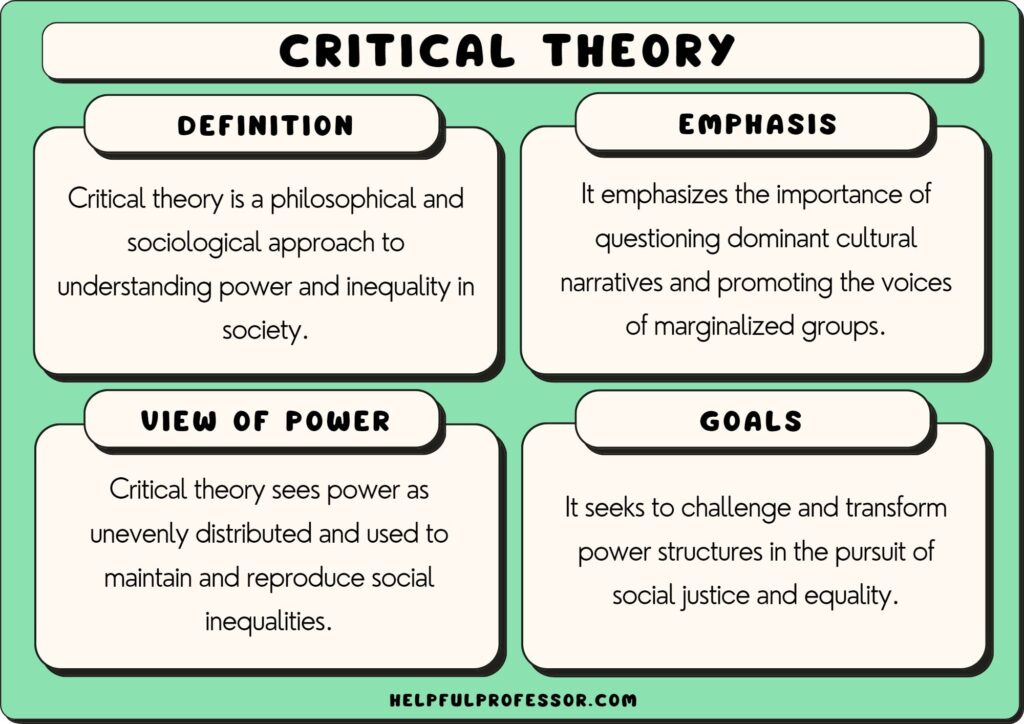
This is why everyone who claims they align with earlier feminist ideas but not with the current movement fails to recognize that the current expression of feminism is the logical conclusion of an ideology that is founded on Marxist principles of power struggles within groups. Even though initially that could’ve meant that feminism had goals that could be reconciled with the Catholic view of human dignity, it was always logical that as time went on, it would degenerate into what we see today.
As we said, the problem is the foundation of both belief systems: one seeks to respect women’s dignity because they are made in God’s image and have intrinsic worth, whereas the other seeks to elevate women because they’ve been “subjected to historic oppression”. The starting point largely determines how a movement will develop over time.
That is why it’ll always be problematic to associate feminism with the Christian worldview, even if by accident some of their goals might be temporarily aligned.
It’s more fundamental, however, to understand that Catholicism needs —and deserves— to stand on its own, without any qualifiers before or after it. Feminism is simply the most visible current example of a broader problem: the attempt to combine Catholicism with other totalizing worldviews.
Catholicism and Other “—isms”
Any attempt to combine Catholicism —and I’m using the term here interchangeably with “Christianity”— with another ideology or belief system will always do a disservice to the faith, because it reduces it to a set of principles that you can adapt or pick and choose however you like. Christianity is an all-encompassing worldview, that cannot be limited nor combined with other belief systems that are also all-encompassing when they are tied to your identity.
You cannot be a Catholic Feminist anymore than you can be a Catholic Marxist or a Catholic Fascist. You could even argue that, if you’re a Christian, no political or ideological label (republican, democrat, liberal, conservative, etc.) should precede or supersede your Catholic identity. There is room within the faith to hold particular economic or social positions, but every secular belief system will eventually conflict with the Christian worldview. The moment you place the ideology first and Catholicism second, you have reduced the faith —which should be your guiding light— into a merely optional and flexible set of beliefs you can pick and choose however you like.
Chesterton points to this truth in Orthodoxy, when he described how he had attempted to construct his own philosophy from scratch, only to discover that “when I fancied that I stood alone I was really in the ridiculous position of being backed up by all Christendom.”
Every ideology eventually arrives at a question Christianity has already answered, and answered better. Every “—ism” eventually conflicts with the Christian worldview. It’s dangerous to think you can hold multiple all-encompassing sets of beliefs at once, because eventually you will be forced to choose one, and what usually happens is that the most self-imposing ideology triumphs, and that is not Christianity, because, unlike most ideologies, the faith does not impose itself through social pressure or tribal identity.
Conclusion
You can absolutely be more aligned with conservative or liberal policies, but in order to be truly Christian you must maintain your total independence from political and ideological labels, because otherwise you will always end up reducing the importance of the faith so that it fits the ideology you base your identity on.
You are Catholic, period. Say it with your chest, without watering it down with other qualifiers that only seek to make the faith flexible and individualistic.
Ad Maiora Nati Sumus,
Juan


Thank you for reading!
If you enjoyed this post and could leave a like or comment it would be greatly appreciated, as it will help my work reach more people.
Also, if you liked this article, you’ll love my book.