



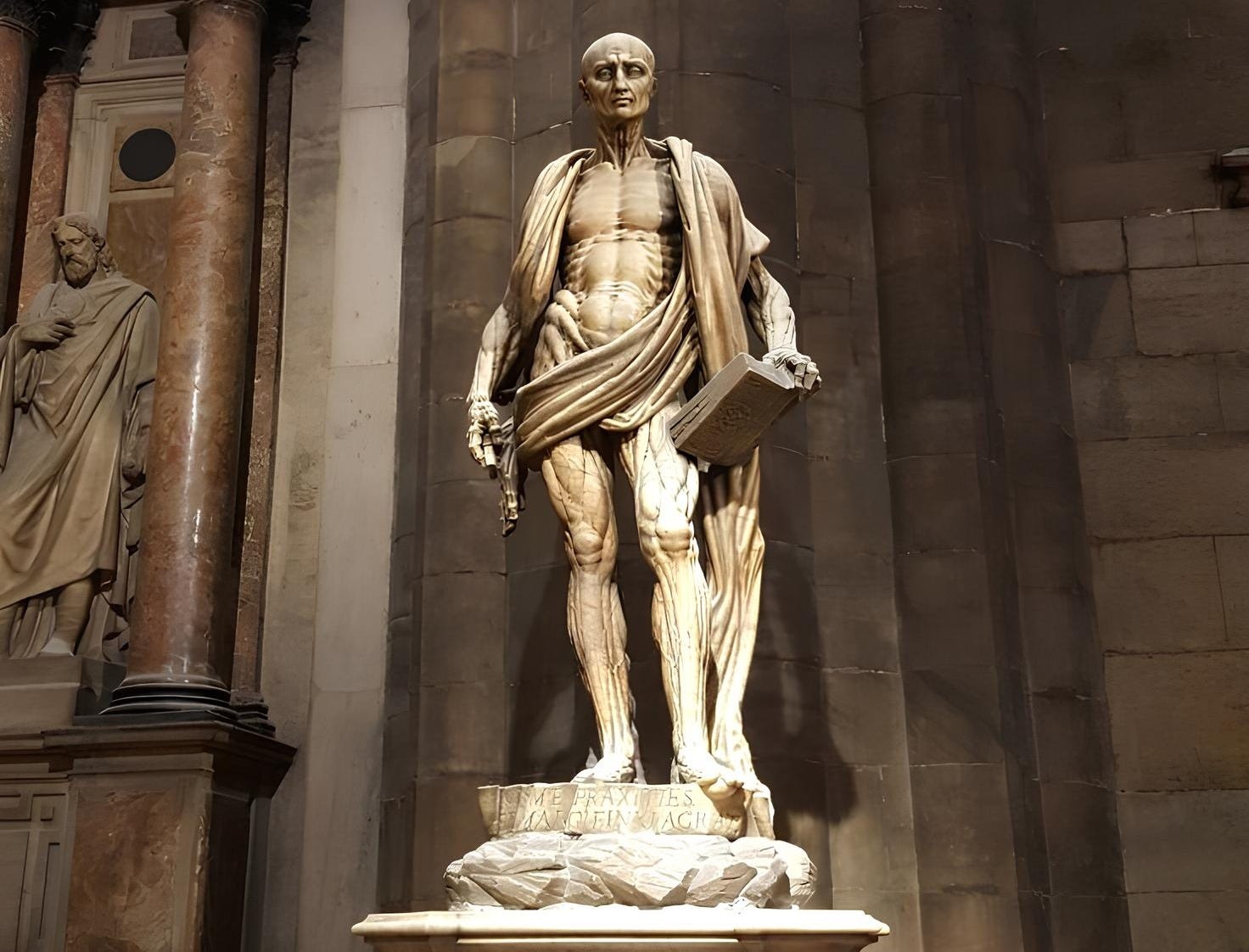
I remember when I first started Simple Men Blog, back in 2021. I was instantly introduced into a side of the internet that I didn’t even know existed: a bunch of mostly anonymous accounts creating content about masculinity, traditional values, and the pursuit of virtue.
I was pleasantly surprised to find that I wasn’t the only one who felt there was a widespread masculinity problem, and it was reassuring to find myself surrounded by a lot of other men —many of whom have since become friends— who were committed to restoring the virtues we had lost.
But somewhere along the line, the conversation about masculinity became mainstream. It became popular and crowded. What used to be a niche side of the internet composed mostly of men who were sincerely devoted to sharing a message of strength and honor among men became flooded with scammers, frauds, grifters, and ill-intentioned men and women who saw an opportunity to get rich by preying on lonely, alienated young men.
“Trad masculinity” accounts started spawning left and right, crusader pics all over the place, each one promising young men a more effective solution to their problems. Many of these accounts were exposed as frauds living double lives: preaching virtue online while living a life completely opposite to the values they promoted. What’s even worse, many of these “based, masculine accounts” claimed to be Christian, confusing the message of the Gospel with pseudo-Christianity built on resentment and self-glorification rather than love and sacrifice, essentially the masculine version of the feminism they claim to oppose.
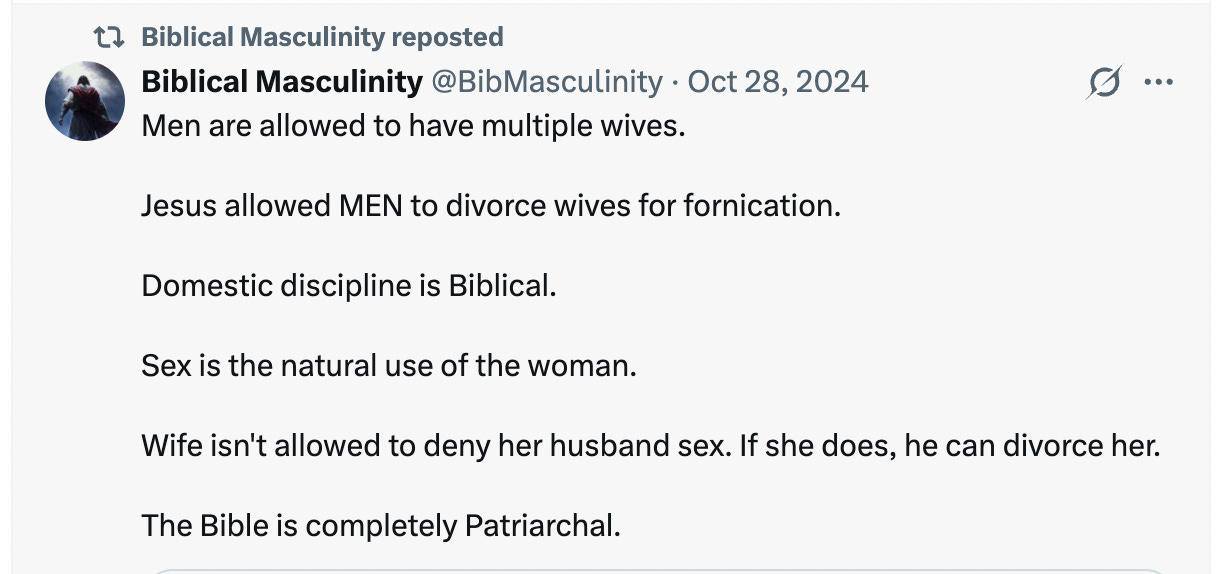
Lots of young men, desperate for guidance and mentorship, jumped on the bandwagon and started following these dogmas, idolizing the anonymous crusader accounts spewing comfortable lies and sad excuses for sin passing as “theological truths”:

I’m not writing this article to claim I’m “one of the good ones” or throw shade at anyone. If you’ve been reading my work for a while, you know that’s not the way I like to operate, because many of these men started with good intentions and got lost along the way, while others are genuinely trying but have fallen into traps they don't recognize. I've caught myself in these patterns too: caring too much about how an article will be received, checking engagement metrics, feeling superior. The temptation to perform rather than practice the more challenging aspects of our faith is very real, and I'm not immune to it.
Thus, my goal with this article is to raise a call for coherence between what we preach online and what we practice, not just for those of us with some sort of public forum, but for any man who calls himself a follower of Christ.
It’s become too easy to signal traditional masculine values without living them, too easy to critique stuff online without ever trying to build something meaningful.
The real problem lies in the fact that many men have unwillingly internalized the false notion that the performance is the virtue, leading them to pursue the appearance of strength instead of the real strength all Christians are called to.

Three Types of Incoherence
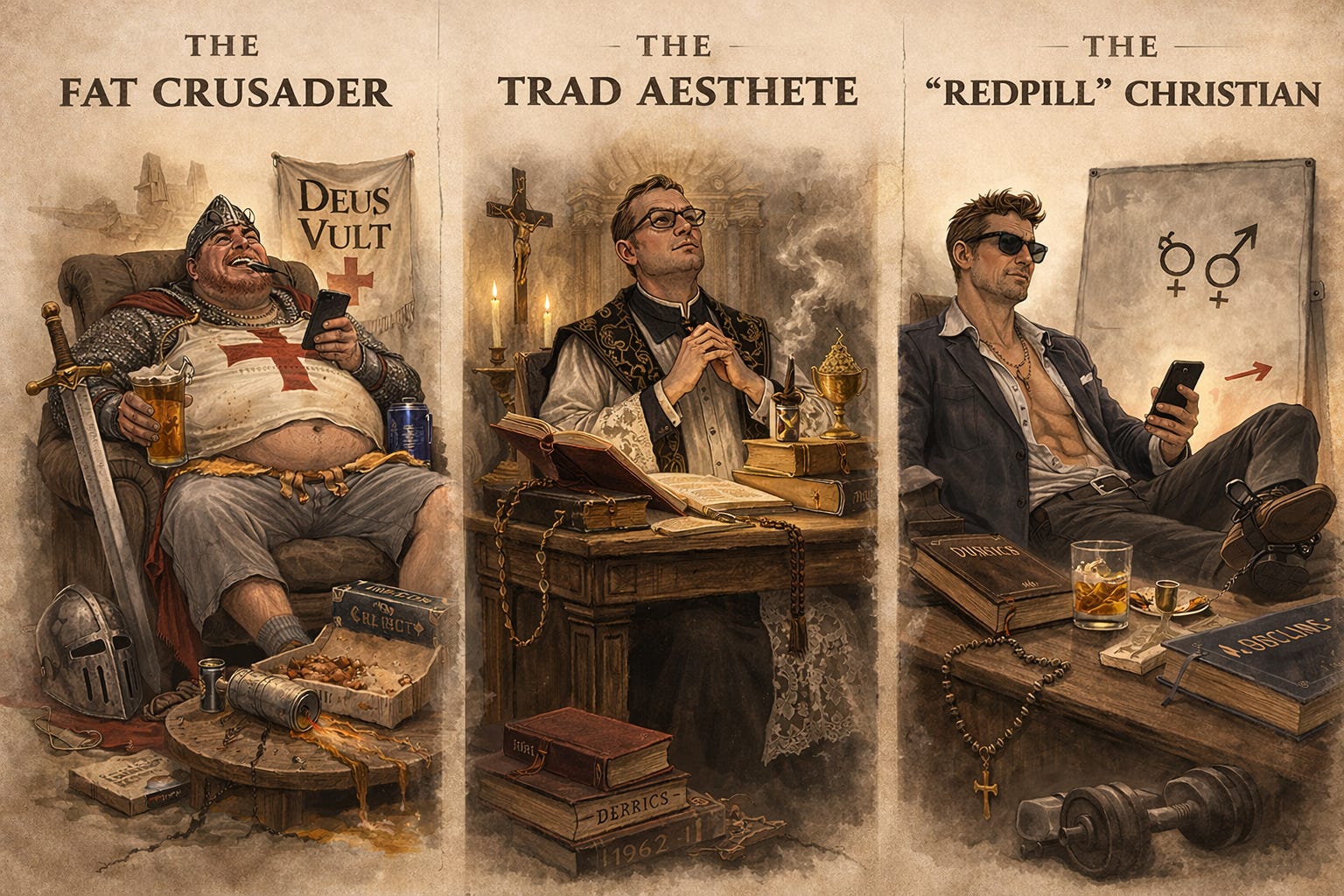
In my years writing online, I’ve come to identify three profiles in which the problem of performative masculinity is exemplified. Before I describe these three patterns, let me be clear: I'm not writing about specific men on the internet I want to mock. I'm writing about patterns I've seen and even noticed in my own life and journey as well.
I share these not only for you to be able to recognize potentially misleading accounts, but more so to warn you against becoming them. Like I said earlier, I’ve caught myself acting like this multiple times, and I know firsthand how important it is to be aware of these “archetypes” so as not to fall for them:
The Crusader LARPer: This is the guy who’s obsessed with medieval Christendom, who reads about the crusades constantly, uses crusader imagery, loves warrior saints, and “Deus Vult” memes. Now, these things are not bad in and of themselves —we should all learn from the warrior saints and crusader imagery is phenomenally motivating—, the problem is when these things become a sort of escapism from a life of laziness and effeminacy. It’s hollow and performative when the guy with the crusader profile pic can’t even fast on Fridays or won’t make a genuine effort to discipline his body by practicing asceticism and self-denial.
The Trad Aesthete: I love the Latin Mass and traditional forms of worship. They're profound, reverent and incredibly beautiful. But I have seen many men who, in their desire to restore the reverence and depth of the more traditional Catholic practices, fall into a sort of spiritual superiority and pride in which everyone who attends a Novus Ordo mass or who doesn’t know every single liturgical detail is dumb or inferior. And again, it’s okay to be opposed to the lack of reverence shown in some modern forms of worship, and it’s okay to speak up against it. It’s also okay (and recommended, and necessary), to study the history, tradition, and doctrine of the Church. But never is it okay to do it from a position of prideful superiority. The incoherence here lies in the excessive desire to appear pious and traditional, while ignoring or forgetting the much harder work required to achieve holiness through humility of the heart.
The Pharisee stood and prayed thus with himself, ‘God, I thank thee that I am not like other men, extortioners, unjust, adulterers, or even like this tax collector. I fast twice a week, I give tithes of all that I get.’ But the tax collector, standing far off, would not even lift up his eyes to heaven, but beat his breast, saying, ‘God, be merciful to me a sinner!
— Luke 18:11-13The "Redpill" Christian: This is the guy from Exhibits A and B, who uses an erroneous interpretation of the Gospel to justify sexual immorality and his tendencies to capital vices. He posts constantly about masculine/feminine roles and “sexual dynamics”, and yet doesn’t pursue the virtue of chastity, and conveniently ignores all the Bible verses that contradict him. More often than not, these men are also consumed by pride and have molded “their Christianity” to justify their preferences and sinful inclinations rather than conforming their lives to Christ.
What they all have in common is that these profiles of men feel strong and masculine, without actually doing the hard things that masculinity requires. Their virtue signaling gives them the dopamine hit they want, without the cost and without the necessary humiliation that always accompanies actual growth.
The consequence of prioritizing appearance over reality is almost always the same: these men become profoundly prideful, as they receive the reward of feeling masculine without the struggle and humiliation that comes as a byproduct of the pursuit of virtue and serves to balance the tendency to think ourselves hotshots.

How Pride Creeps In
This performative masculinity inevitably leads to pride because pride feeds on the appearance of virtue: by aiming to be seen as virtuous, we slowly start to believe we are, even if we live hypocritically. Thus, slowly, pride gets into your heart, and you start caring more about being perceived as virtuous and “based” than about actually becoming virtuous.
It all comes down to intention: are we acting to please God out of love for Him? Are we pursuing virtue to glorify Him?
Or alternatively, are we acting to gain approval and recognition from the world for being so pious/strong/moral/”based”?
These are questions that every man needs to be asking himself constantly, to avoid the subtle temptations of pride. Pride is very sneaky, and it can mimic every virtue. But contrary to actual, sacrificial virtue, the prideful substitutes are always about the self: how I appear, how I'm perceived, how superior I am to those other weak/liberal/effeminate men.
True Virtue Requires Humility
Without humility, you’ll never be able to look at your strengths and weaknesses honestly, and recognize what you need to work on. Real growth always requires some form of humiliation, or at least the risk of it:
The beginner risks looking foolish
The man learning to pray risks stuttering and stumbling through the words
The man building a business risks failing
The man asking a woman out risks getting rejected (or even mocked)
The man confessing his sins must admit them aloud
Pride, hiding behind performative masculinity, on the other hand, offers an easy cop-out: “you’re so based. Thank God you’re not like those soft liberal men. Modern women are degenerate so why even ask any of them out.”
Pride convinces you that you’re already there and gives you comfortable excuses to avoid the effort and hard work required to become a man of real, solid virtue.
Deep down, the internal monologue is something like: “If I can convince others (and myself) that I'm already the strong traditional Catholic man, I never have to endure the humiliation of actually becoming one.”
Prideful Judgment
Finally, what usually happens when a man falls for the counterfeit version of masculinity that only performs in public without any real foundation is that he becomes too comfortable passing judgment on others.
Because the performative man isn’t really building anything (not his own life, not a business, not a marriage), he spends all his time focusing on the sins of others, passing judgment and criticizing those who are at least trying but often failing.
Critique protects the image of virtue that pride has constructed, and it allows the performative man a way to continue virtue-signalling without ever taking any real risks:
Starting a business might fail
Leading a ministry might reveal my inadequacy
Getting married means someone will see all my flaws
Having children means I can’t hide my weakness
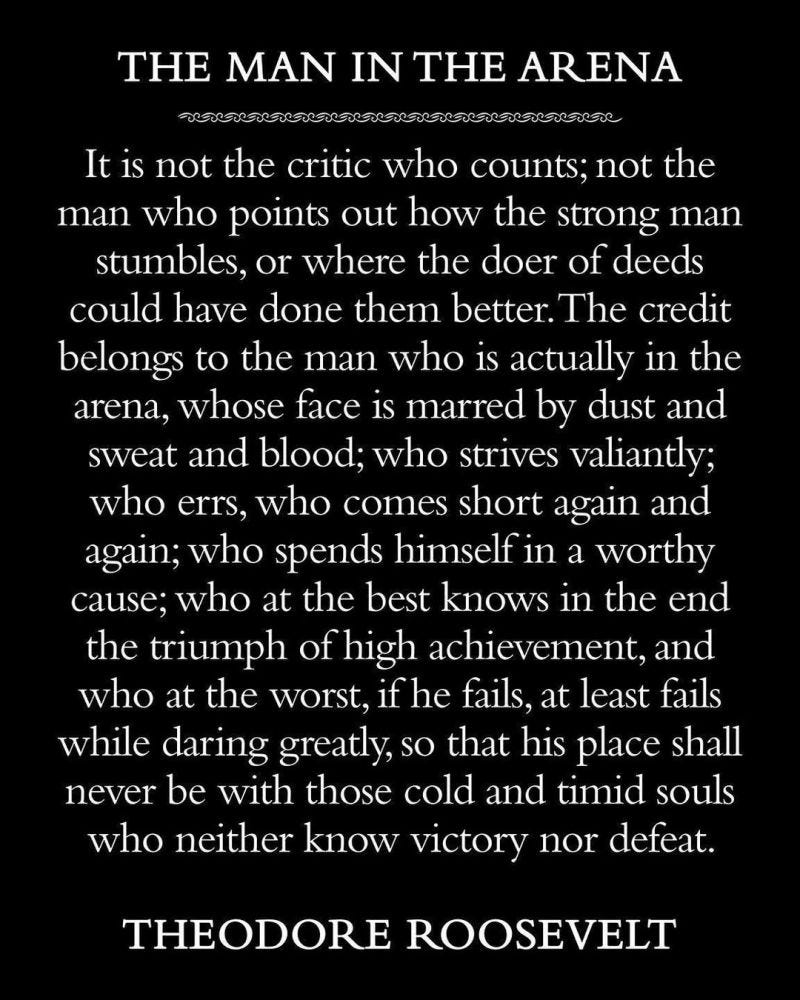
Yet these are precisely the risks that all men must face when they enter the arenas of life. The prideful, performative man is really masking a deep cowardice, pointing and laughing from the stands at those bleeding in the arena.
The Way Forward
Humility is tough man. It’s a hard virtue to acquire because pride is so subtle that we often cannot even notice the hold it has on our hearts. I believe it’s always wise to examine ourselves thoroughly and ask the Holy Spirit to help us see.
I want to propose an exercise for you (one that I’ll do myself too), so that we can analyze objectively if we’re falling for the trap of performative masculinity. Ask yourself these questions, and try to be as honest as possible when answering them:
Do you spend more time criticizing or making fun of weak men than helping them?
Do you sometimes feel superior to other Catholics who aren’t as “trad” or “based” as you?
Do you feel someone might “expose you” for not practicing what you preach?
Would someone watching your life (not your feed) call you virtuous?
Can you go 30 days without posting about masculinity and still feel like a man?
When was the last time you did something genuinely hard that no one saw?
Are you building anything real? (Business, family, ministry, skill)
When was your last confession?
If you answered honestly, you probably noticed areas where you need to grow. I certainly did. And that’s the point: we need to shift our focus from appearance to reality, from performance to practice. We need to align our public preaching with our private deeds, and not merely online, but most importantly, in the hidden moments when only God is watching.
The Church doesn’t need any more men living double lives, preaching a message and living another. God knows how much damage this has already done.
And it’s not about never sinning. We will always stumble and struggle. Some more than others. It’s about being open about your battles, about the fact that you’re not “the perfect crusader”, but just another man doing his best to find, love, and honor Christ. Not a perfect example of virtue, but a sinner saved by grace.
May we all muster enough courage to take the risks necessary for growth, may we all enter the arena strengthened by our love for Christ, and offer a helping hand to those who are struggling even more than us.
May God grant us the grace of a humble heart, one that surrenders completely to the Lord, one that leads us towards purposeful action, not to gain applause or recognition, but to honor God with total self-denial and a life of humble sacrifice, thus walking firmly towards the highest peaks of masculine virtue.
Ad Maiora Nati Sumus,
Juan

Thank you for reading!
If you enjoyed this post and could leave a like or comment it would be greatly appreciated, as it will help my work reach more people.
If you liked this article, you’ll love my books.

What does a man do, when despite knowing the truth, despite his effort, he feels like God still hates him? When the world discourages and derails him, even among the brethren?
Again and Again. you continue to hit the soft wounded spots that we all have but try to make believe it doesn't exist, till articles like yours shine a light on them, basically waking us to always look into ourselves before point fingers. My father ( RIP) used to say this. he was a farmer; "Make sure your finger is 100% clean, before point it at someone". Well done Sir! I never get tire to recommend this book; Humility of Heart, by Father Father Cajetan (Gaetano) Maria da Bergamo. By the way, not to under mind your books, they're also excellent.