



When the first news of “The Odyssey” casting came out, I was tempted to boycott the movie altogether. I did not want to financially support Hollywood’s latest effort to further their progressive agenda, and it felt wrong to give my cash and attention to a movie that so clearly perverted Homer’s masterpiece.
After giving it some thought, however, I decided that I would watch it with a critical eye, because if I was going to speak about the movie, it would be hypocritical to do so without having watched it. And, as a cultural commentator, I thought it was appropriate to write this piece sharing my thoughts on it.
If I could describe the movie in one word, it would simply be disappointing. It’s not a bad movie, but it’s definitely a movie that does Homer’s epic no justice. The Odyssey is one of the greatest stories ever told, one of the most significant and foundational texts of Western culture and European literature. It’s essentially critic-proof. And that’s what makes the movie Nolan produced all the more frustrating: it’s an average film from perfect raw material.
Matt Damon Starring as Matt Damon
Let’s quickly discuss the elephant in the room: some of the casting choices were absolutely preposterous and insulting to the source material. Lupita Nyongo might be a good actress, but she clearly fails to fit Homer’s “white-armed” description of Helen of Troy.
Ellen/Elliot Page is not a man, and yet we are supposed to believe and accept that she is, and Nolan goes so far as to make sure that the character of Odysseus calls her “the bravest man I ever knew” at one point in the film. Athena is mixed-race, Eurylochus is Indian, one of Odysseus’ sailors is asian, a few are black, and all in all, the casting choices make sure that you cannot ever truly believe this story takes place in Greece.


But even if we do a titanic effort to ignore the ridiculously obvious ideological cast that Nolan chose, there are many other meaningful problems with the rest of the actors, even though they might physically look somewhat at home in the ancient Greece of Homer’s story.
The main problem here is that Nolan chose the same actors we’ve seen ad nauseam in every single Hollywood movie of the last decades, and for a story as impressive as The Odyssey’s, this makes it difficult to buy into the world that the movie tries to create. Worst of all is the fact that the director apparently didn’t really care about making the actors resemble the characters, opting instead to adjust the characters to match the actors.
The result of this is that Jon Bernthal acts exactly as he does in all his other movies, Tom Holland stars as Tom Holland, Matt Damon as Matt Damon, and so on with every single main character. I don’t seem to remember Menelaus having such a thick New-York accent in the books.
When you use such well-known, established actors, you make it impossible for the audience to not be aware that they are watching actors perform a role, destroying the immersive potential of a production of this magnitude. You are too aware that you’re watching Jason Bourne, Spiderman, and The Punisher put on costumes and play pretend. This might be okay for less “epic” movies, or for those productions that take place in contemporary times, but for a historical (even a mythological) film, using actors this famous and this repeated make it impossible for the viewers to be transported to the time period the movie tries to portray.
An Uninspiring Hero
The character of Odysseus in Homer’s books is a man of great ambition, cunning, proud, witty, incredibly smart, and deep. Damon’s representation? Emotionally distant and just plain unremarkable. He lacks the weight of a hero like Odysseus, presented more like a war veteran with PTSD than as the profoundly masculine yet emotionally complex hero that makes the story so great.
Much have I suffered, labored long and hard by now
in the waves and wars. Add this to the total—bring the trial on!
— The Odyssey, Homer, Book VIII1
Nolan’s Odysseus is bland and boring, and you watch him move through the film without ever feeling the specific gravity (the “aura” if you will) that Homer's character carries from the first book to the last. He is competent, occasionally clever, and yet entirely forgettable. This is almost an achievement in its own right, given the source material.
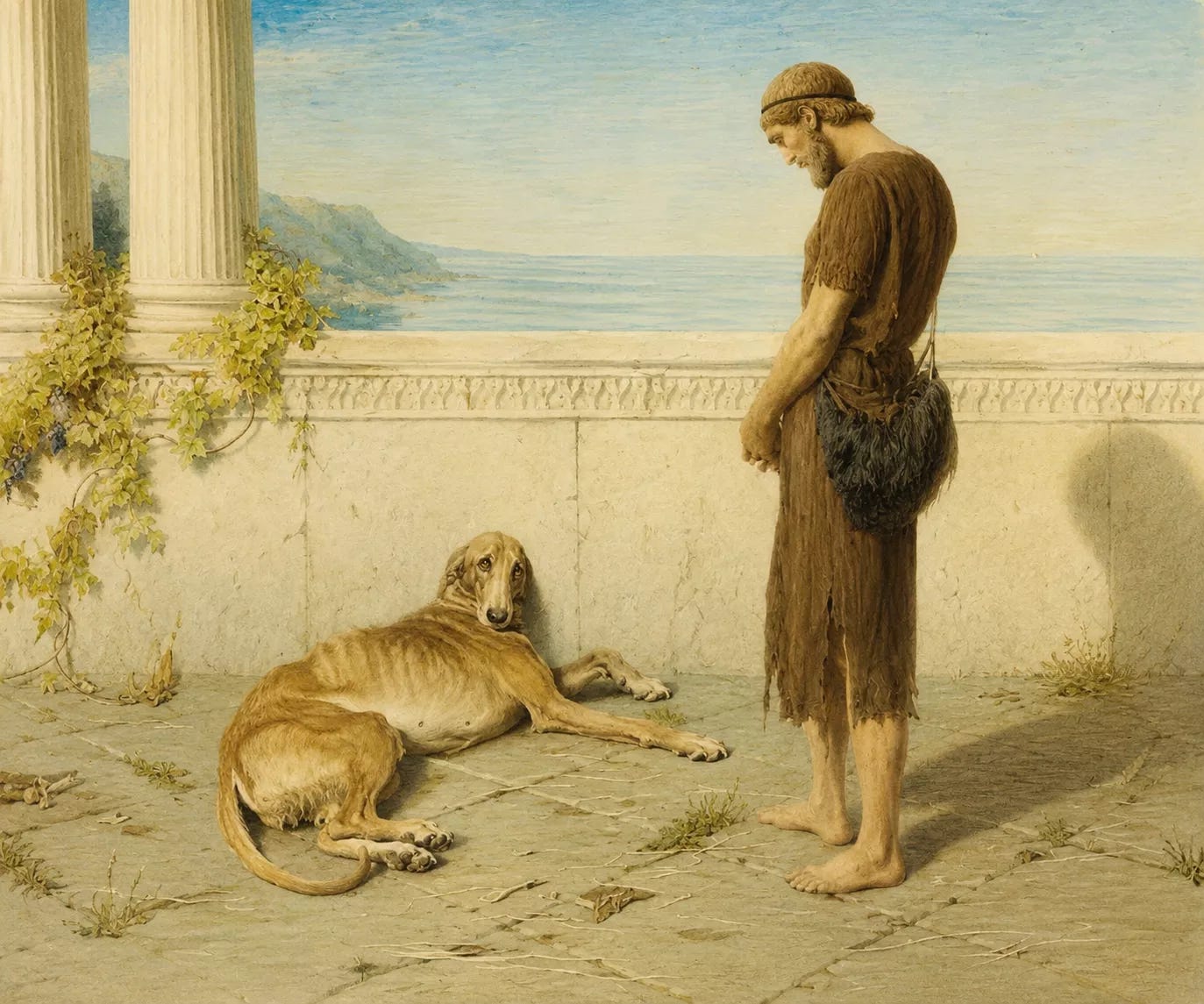
Matt Damon’s representation showcases a veteran haunted by guilt, so much so that he doesn’t actually want to go home because he’s afraid of what he’ll find there. By the time that he finally reunites with his son, his wife, and dying dog, we don’t really care, because the man at the center of it does not seem to feel the weight of what he has returned to.
An Epic World Made Ordinary
A bland main character and a cherrypicked diverse and repetitive cast are problematic enough for the immersion experience, and the final nail in the coffin comes from what I can only describe as Nolan’s middle finger to anyone who wanted the Odyssey to inspire and fill them with wonder: the “ordinarization” of what should be a world filled with poetry.
YouTube user The Critical Drinker accurately mentions in his review how the film is “a clinical, precise, finely engineered movie made by a man of great technical skill who seems to lack the romantic soul and the wonder and the sheer humanity to bring it all to life.”
The movie is technically well-made, the cinematography is stunning, and sometimes, almost accidentally, you feel something move within you. But that feeling fades away almost instantly when Odysseus, back in 1200 BC, on the shores of Troy, tells his crew: “Ten years on this fucking beach. Let’s go home.”
Nolan took the mythological world of Homer’s poem and brought it down to the most ordinary representation: in the dialogue, in the accents, in the lack of interaction with the Greek gods and in the way that it feels like just another action movie.
The Odyssey should have been one of those movies that remained timeless, but the dialogue and ordinary adaptation of the source material makes that impossible.


The clunky, modern dialogue and accents ensure that this movie will only be relevant for a few months or years, a modern, ordinary portrayal of a timeless story that will fade away with time.
Contributing to this is the removal of all interaction with the gods, a central point in Homer’s book. Whereas in both the Iliad and the Odyssey the gods are physically present, intervening in both the war and Odysseus journey, in the movie they are portrayed more as forces of nature with which the characters never interact directly. The only god that appears is Athena, portrayed by Zendaya in a strikingly insipid way, who acts more like Odysseus’ conscience than as an active participant in his story, simply showing up to give him a dissappointed look which further fuels his guilt.
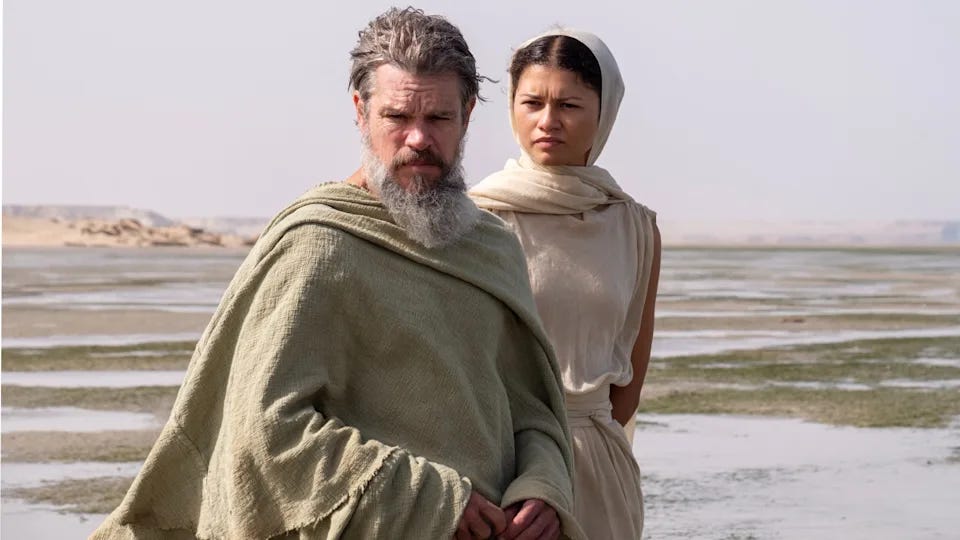
Nolan made sure to create an uninspiring world without trascendence, an entertaining movie without a soul, and a set of characters clearly unwilling to help the audience believe the story.
Subtle Feminism
Finally, one thing in particular that bothered me was the subtle feminism evident in certain scenes and interactions, of which I’d like to briefly mention two in particular:
The first is a scene involving Penelope and Telemachus in which she delivers what amounts to a small political speech, claiming that the throne of Ithaca is not empty because she has been sitting on it for twenty years, and dismissing her son’s claim to rule with the remark that “her experience amounts to nothing more than the bristles on his chin”. Apparently Nolan’s Penelope hates the idea that only a man could or should rule Ithaca, and she feels as if this was a huge injustice that she has been enduring. This doesn’t reflect Homer’s Penelope, a faithful wife whose fidelity is the moral center of the entire epic. Rewriting her as a proto-feminist was not only unnecessary, but an insult to what should be an exemplary traditional female character.
The second is Circe. In Homer’s Book X of the Odyssey, the transformation of Odysseus’s men into pigs has no ideological motive, it is a divine and symbolic act, representing the loss of reason and self-control that comes from yielding to temptation. Odysseus proves himself before Circe, and she becomes his ally, his lover, and ultimately his guide providing him with the knowledge he needs to visit the underworld without which he could not complete his journey home. Nolan’s version imports an entirely different reading: Circe transforms the men into pigs because she believes that is what men fundamentally are. This is a filtering of Homer through Madeline Miller’s feminist novel Circe, which explicitly set out to reshape and reinterpret the source material from a contemporary ideological perspective.
At this, Circe, taking her wand, went out of the hall and opened the gates of the sty, and drove out what seemed to be full-grown pigs. They stood there and she went among them smearing each one with a fresh potion. Then the bristles, that Circe’s previous hateful spell had made them sprout, fell from them, and they became men again, younger and handsomer and taller by far than they were before. They knew me now, and each man clasped my hands, and all were wracked with weeping, till the walls echoed, mournfully, and even the goddess was moved to pity.’
— The Odyssey, Homer, Book X2


Conclusion
Perhaps there are other things that are wrong with the movie, but these are the ones I remember most vividly. And to be fair, there are also many good things with it: the cinematography, the music, the story (obviously), and the production quality. It’s not a terrible movie, it’s just a dissappointing adaptation of a text that means a lot to anyone who cares about history and literature.
All in all, however, I came out of the theater feeling somewhat sad. Not because the movie hadn’t fulfilled my expectations, but rather because it was exactly what I expected: a well made movie that takes Homer’s poem, twists it significantly, removes the soul from it, and regurgitates it back, in Nolan’s words, to a “modern audience”, who are ready to consume it without noticing or caring about the subtle ideologies hiding behind the impressive takes.
It’s sad that this is what we got from one of the most significant and foundational texts of Western civilization. A movie exclusively created to win an Oscar and appease the Hollywood elites.
Ad Maiora Nati Sumus,
Juan


Thank you for reading!
If you enjoyed this post and could leave a like or comment it would be greatly appreciated, as it will help my work reach more people.
Also, if you liked this article, you’ll love my book.

https://www.poetryintranslation.com/PITBR/Greek/Odyssey10.php#anchor_Toc90267909
https://www.poetryintranslation.com/PITBR/Greek/Odyssey10.php#anchor_Toc90267909
Wonder if one did Roots with an all or entirely Caucasian cast? 😱 what Irish people were slaves! No one’s heard of the North African slave trade? The Barbary pirates? Barbary slave trade involved the capture of an estimated 1.25 million Europeans and 700 Americans, then selling them at slave markets, or ransom payments by America to purchase their freedom. At one point 20 percent of the U.S. federal purse! Which is why George Washington demanded the creation of a United States Navy! Why do they not make a movie about that? White makes and Women abducted and sold into slavery or sexual slavery in N.Africa to Moslem pirates? 🏴☠️
https://youtu.be/swt2A6iHgNw?si=AdsJ7XNTo2sa8zn_
Great review, you point out the things that actually matter (more than the DEI casting) and solidify why I'll never watch it.